

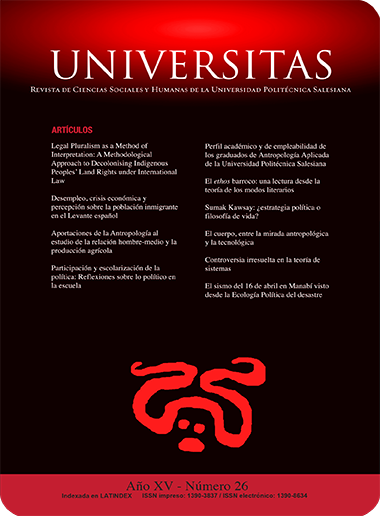
Legal Pluralism as a Method of Interpretation: A Methodological Approach to Decolonising Indigenous Peoples’ Land Rights under International Law
Article Sidebar
Main Article Content
Abstract
Ever since the arrival of the European colonisers, theories of international law have been used to justify the process of dispossession of indigenous lands. Even though the adoption of human rights have led to some amelioration, the author claims that this has proved unsatisfactory to address indigenous concerns for one reason: international law remains deeply rooted in colonial concepts, such as the concepts of ‘sovereignty’ and ‘property’. Given that these concepts clearly contradict indigenous cosmovisions, the author proposes a pluralist interpretation of indigenous land rights under international law. Understood as a method of interpretation, it is able to take into account not only ‘state law’ but also indigenous conceptions of the relationship between human beings and the land. It is thus proposed that such a methodological approach may decolonise colonial concepts of international law.
Article Details
Universitas-XXI Journal aligns with the principles of open access and academic collaboration by adopting the Creative Commons Attribution-NonCommercial-ShareAlike 4.0 International License (CC BY-NC-SA 4.0). This license ensures that published content can be used and shared widely under the following conditions:
Attribution: Authors and the journal must be appropriately credited as the original creators of the content, with full reference and a link to the publication provided.
Non-commercial use: Content may not be used for commercial purposes, preserving its academic and educational intent.
ShareAlike: Derivative works must be distributed under the same terms as this license, promoting the creation of accessible and equitable knowledge.
By implementing this license, the Universitas-XXI Journal strengthens its commitment to disseminating high-quality research, providing free access to knowledge, and fostering a collaborative environment among researchers, educators, and students worldwide.
This decision reflects core values of responsibility, ethics, and transparency in academia, ensuring that intellectual contributions serve as a foundation for new research and projects while respecting the rights of authors and the scientific community.
For more information about this license, please visit the following link: https://creativecommons.org/licenses/by-nc-sa/4.0/"