

Análisis del Rendimiento de D-BLAST MIMO sobre SDR-USRP
Barra lateral del artículo
Contenido principal del artículo
Resumen
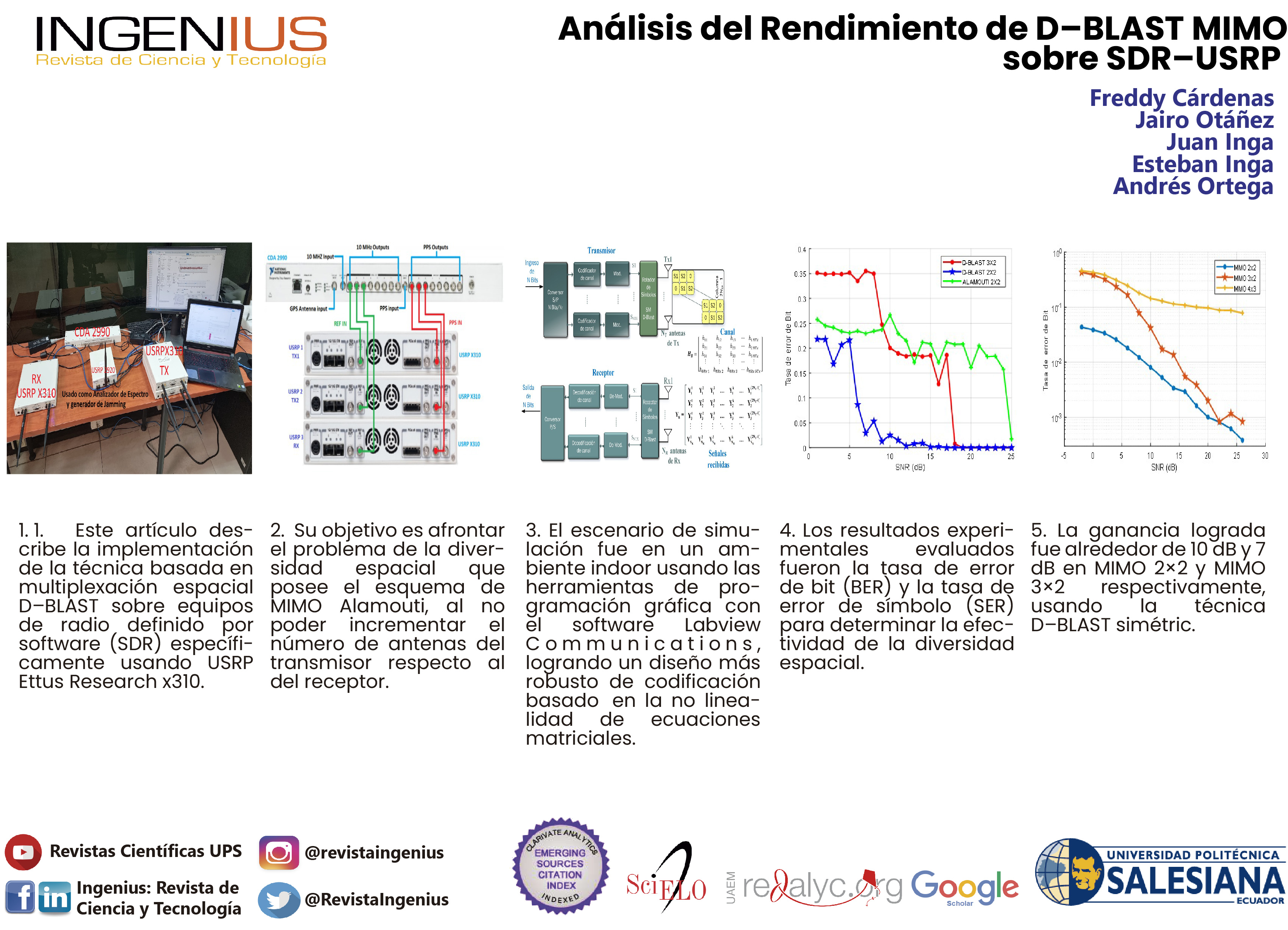
Este artículo describe la implementación de la técnica basada en multiplexación espacial D–BLAST sobre equipos de radio definido por software (SDR) específicamente usando USRP Ettus Research x310; con el objetivo de afrontar el problema de la diversidad espacial que posee el esquema de MIMO Alamouti, al no poder incrementar el número de antenas del transmisor respecto al del receptor. El escenario de simulación fue en un ambiente indoor usando las herramientas de programación gráfica con el software Labview Communications, logrando un diseño más robusto de codificación basado en la no linealidad de ecuaciones matriciales, mitigando, de este modo, a través de la redundancia de información los efectos de la interferencia que genera el incremento propio de las antenas en el transmisor. Los resultados experimentales evaluados fueron la tasa de error de bit (BER) y la tasa de error de símbolo (SER) para determinar la efectividad de la diversidad espacial. La ganancia lograda fue alrededor de 10 dB y 7 dB en MIMO 2×2 y MIMO 3×2 respectivamente, usando la técnica D–BLAST simétrica.
Detalles del artículo
La Universidad Politécnica Salesiana de Ecuador conserva los derechos patrimoniales (copyright) de las obras publicadas y favorecerá la reutilización de las mismas. Las obras se publican en la edición electrónica de la revista bajo una licencia Creative Commons Reconocimiento / No Comercial-Sin Obra Derivada 4.0 Ecuador: se pueden copiar, usar, difundir, transmitir y exponer públicamente.
El autor/es abajo firmante transfiere parcialmente los derechos de propiedad (copyright) del presente trabajo a la Universidad Politécnica Salesiana del Ecuador, para las ediciones impresas.
Se declara además haber respetado los principios éticos de investigación y estar libre de cualquier conflicto de intereses.
El autor/es certifican que este trabajo no ha sido publicado, ni está en vías de consideración para su publicación en ninguna otra revista u obra editorial.
El autor/es se responsabilizan de su contenido y de haber contribuido a la concepción, diseño y realización del trabajo, análisis e interpretación de datos, y de haber participado en la redacción del texto y sus revisiones, así como en la aprobación de la versión que finalmente se remite en adjunto.
Referencias
[2] M. Danneberg, N. Michailow, I. Gaspar, M. Matthe, D. Zhang, L. L. Mendesy, and G. Fettweis, “Implementation of a 2 by 2 MIMO-GFDM transceiver for robust 5G networks,” 2015, pp. 236–240. [Online]. Available: https://doi.org/10.1109/ISWCS.2015.7454336
[3] N. Prasad and M. K. Varanasi, “Analysis and optimization of diagonally layered lattice schemes for MIMO fading channels,” IEEE transactions on information theory, vol. 54, no. 3, pp. 1162–1185, 2008. [Online]. Available: https://doi.org/10.1109/TIT.2007.915701
[4] B. Clerckx and Claude Oestges, MIMO Wireless Networks. Academic Press Publications, 2013. [Online]. Available: https://doi.org/10.1016/C2010-0-66925-2
[5] Y. K. Chang, F. B. Ueng, and K. Z. Wu, “A novel MIMO-GFDM receiver for next generation communication,” Transactions on Emerging Telecommunications Technologies, vol. 29, no. 6, pp. 1–15, 2018. [Online]. Available: https://doi.org/10.1002/ett.3288
[6] M. Gupta and G. Murmu, “Experimental Study of Fading using Alamouti Space-Time Block Code,” no. 1. IEEE, 2018, pp. 0–5. [Online]. Available: https://doi.org/10.1109/SCEECS.2018.8546851
[7] A. Paulraj, R. Nabar, and D. Gore, Introduction to Space-Time Wireless Communications. Cambridge University Press, 2011, vol. 158. [Online]. Available: https://doi.org/10.1007/978-1-4419-6111-2_2
[8] O. Shental, S. Venkatesan, A. Ashikhmin, and R. A. Valenzuela, “Massive BLAST: An architecture for realizing ultra-high data rates for large-scale MIMO,” IEEE WIRELESS COMMUNICATIONS LETTERS, vol. 7, no. 3, pp. 404–407, 2017. [Online]. Available: https://doi.org/10.1109/LWC.2017.2780079
[9] J. J. Mroczek, M. J. Gans, and L. L. Joiner, “Performance of frequency hopping d-blast mimo architecture using ldpc and bpsk,” in MILCOM 2015-2015 IEEE Military Communications Conference. IEEE, 2015, pp. 860–865. [Online]. Available: https://doi.org/10.1109/MILCOM.2015.7357553
[10] A. Sibille, C. Oestges, and A. Zanella, MIMO: From Theory to Implementation. Academic Press Publications, 2010. [Online]. Available: https://bit.ly/3s2o9uk
[11] G. C. Daily and P. A. Matson, “Ecosystem services: From theory to implementation,” Proceedings of the National Academy of Sciences, vol. 105, no. 28, pp. 9455–9456, 2008. [Online]. Available: https://doi.org/10.1073/pnas.0804960105
[12] Y. Liu, B. Chen, J. J. Mroczek, J. E. Malowicki, and R. J. Michalak, “Robust mimo communications against antenna blockage and interference,” in MILCOM 2019-2019 IEEE Military Communications Conference (MILCOM). IEEE, 2019, pp. 7–12. [Online]. Available: https://doi.org/10.1109/MILCOM47813.2019.9020916
[13] V. Garg, “Fourth generation systems and new wireless technologies,” en. Wireless Communications & Networking. Elsevier, pp. 1–22, 2007.
[14] N. T. Hieu, N. T. Tu, L. T. Danh, A. N. Duc, and B. H. Phu, “Design and implementation of MIMO-STBC systems on FPGA hardware,” International Conference on Advanced Technologies for Communications, pp. 274–277, 2012. [Online]. Available: https://doi.org/10.1109/ATC.2012.6404275
[15] J. Kaderka and T. Urbanec, “Time and sample rate synchronization of RTLSDR using a GPS receiver,” in 2020 30th International Conference Radioelektronika (RADIOELEKTRONIKA), 2020, pp. 4–7. [Online]. Available: https://doi.org/10.1109/RADIOELEKTRONIKA49387.2020.9092398
[16] G. Soni, G. Kaur, and V. K. Banga, “Implementation & BER analysis of 2×2 MIMO Using USRP 2920- universal software radio peripheral,” in 2016 Second International Conference on Computational Intelligence Communication Technology (CICT). IEEE, 2016, pp. 523–527. [Online]. Available: https://doi.org/10.1109/CICT.2016.109
[17] V. S. Muradi, R. K. Paithane, A. Ahmed, and A. Pawar, “Spectrum sensing in cognitive radio using Labview and NI USRP,” in 2018 2nd International Conference on Inventive Systems and Control (ICISC). IEEE, 2018, pp. 1316–1319. [Online]. Available: https://doi.org/10.1109/ICISC.2018.8399019
[18] A. Yanza-Verdugo, C. Pucha-Cabrera, and J. Inga-Ortega, “Compressive Sensing Based Channel Estimator and LDPC Theory for OFDM using SDR,” Ingenius. Revista de Ciencia y Tecnología, vol. 23, no. 1, pp. 74–85, 2020. [Online]. Available: https://doi.org/10.17163/ings.n23.2020.07
[19] N. Narukawa, T. Fukushima, K. Honda, and K. Ogawa, “64 × 64 MIMO antenna arranged in a daisy chain array structure at 50 Gbps capacity,” in 2019 URSI International Symposium on Electromagnetic Theory (EMTS). URSI, 2019, pp. 2019–2022. [Online]. Available: https://doi.org/10.23919/URSI-EMTS.2019.8931517
[20] R. Prieto, A. Abril, and A. Ortega, “Experimental Alamouti-STBC Using LDPC Codes for MIMO Channels over SDR Systems,” in 2017 IEEE 30th Canadian Conference on Electrical and Computer Engineering (CCECE). IEEE, 2017, pp. 1–5. [Online]. Available: https://doi.org/10.1109/CCECE.2017.7946842
[21] V. Soria, G. V. Arevalo, P. Avila, F. Tello, and C. G. Santamaria, “Performance comparison of 2×2 and 4×4 V-BLAST and Alamouti MIMO systems,” in 2018 IEEE 3rd Ecuador Technical Chapters Meeting, ETCM 2018, 2018, pp. 18–21. [Online]. Available: https://doi.org/10.1109/ETCM.2018.8580317
[22] J. J. Anguís Horno, Redes de Área Local Inalámbricas: Diseño de la WLAN de Wheelers Lane Technology College. Escuela Superior de Ingenieros Universidad de Sevilla, 2008. [Online]. Available: https://bit.ly/3IFbsM9
[23] M. Sellathurai and S. Haykin, Space-Time Layered Information Processing for Wireless Communications. Wiley & Sons, 2009. [Online]. Available: https://bit.ly/3oPIjG3
[24] J. R. Hampton, Introduction to MIMO communications. Cambridge university press, 2013. [Online]. Available: https://bit.ly/3DQyhc2
[25] V. Puig Borrás, “Simulación computacional y paralelización de un sistema de comunicaciones inalámbrico MIMO: Estimación de canal y decodificación de señales,” Master’s thesis, Universidad Politécnica de Valencia, 2011. [Online]. Available: https://bit.ly/3IWlitc
[26] Y. S. Cho, J. Kim, W. Y. Yang, and C. G. Kang, MIMO-OFDM Wireless Communications with MATLAB. Wiley & Sons, 2010, vol. 11, no. 3. [Online]. Available: https://bit.ly/3m3QgFN