

Un enfoque de aprendizaje profundo para estimar la frecuencia respiratoria del fotopletismograma
Barra lateral del artículo
Contenido principal del artículo
Resumen
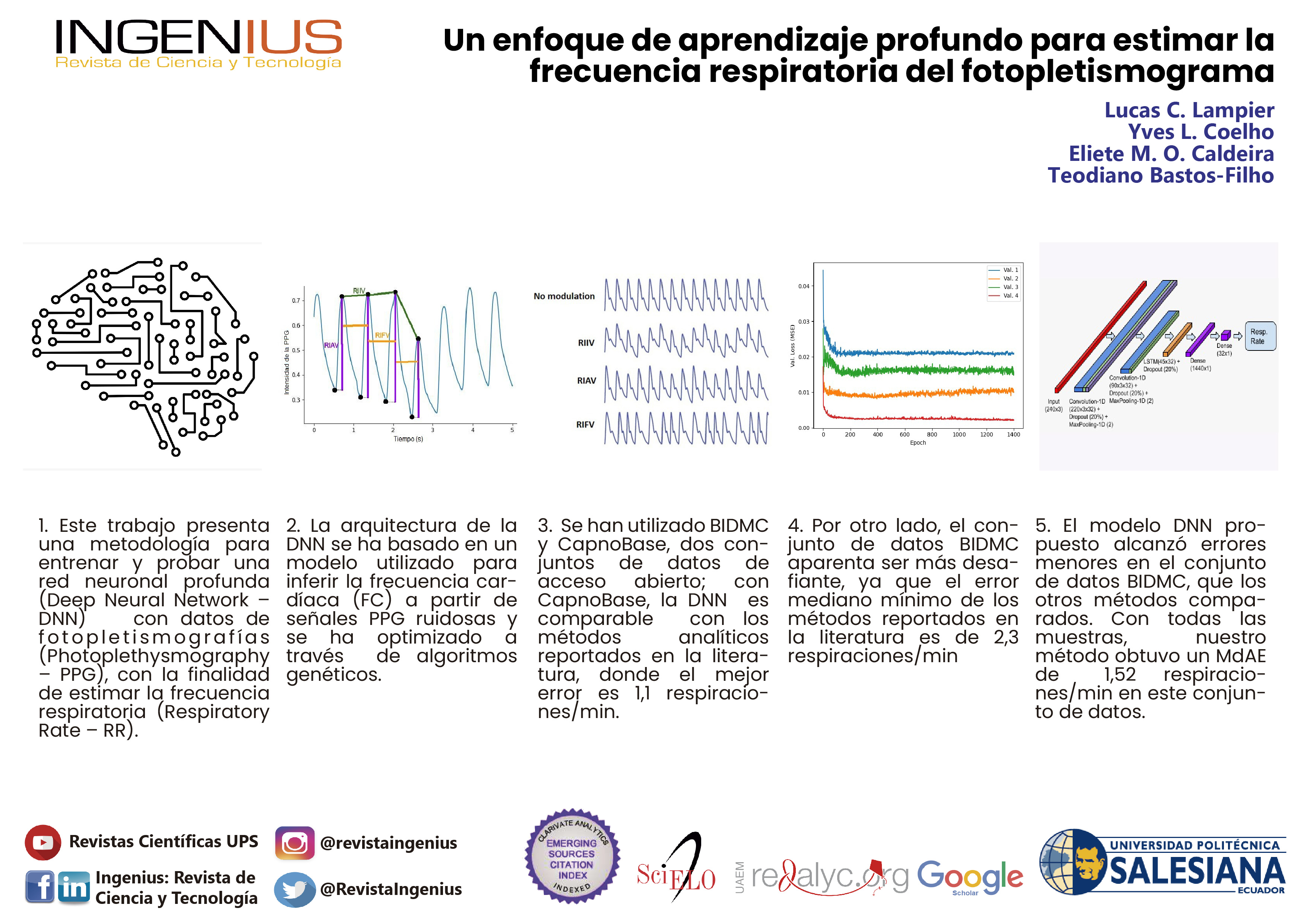
Este trabajo presenta una metodología para entrenar y probar una red neuronal profunda (Deep Neural Network – DNN) con datos de fotopletismografías (Photoplethysmography – PPG), con la finalidad de llevar a cabo una tarea de regresión para estimar la frecuencia respiratoria (Respiratory Rate – RR). La arquitectura de la DNN está basada en un modelo utilizado para inferir la frecuencia cardíaca (FC) a partir de señales PPG ruidosas. Dicho modelo se ha optimizado a través de algoritmos genéticos. En las pruebas realizadas se usaron BIDMC y CapnoBase, dos conjuntos de datos de acceso abierto. Con CapnoBase, la DNN logró un error de la mediana de 1,16 respiraciones/min, que es comparable con los métodos analíticos reportados en la literatura, donde el mejor error es 1,1 respiraciones/min (excluyendo el 8 % de datos más ruidosos). Por otro lado, el conjunto de datos BIDMC aparenta ser más desafiante, ya que el error mínimo de la mediana de los métodos reportados en la literatura es de 2,3 respiraciones/min (excluyendo el 6 % de datos más ruidosos). Para este conjunto de datos la DNN logra un error de mediana de 1,52 respiraciones/min.
Detalles del artículo
La Universidad Politécnica Salesiana de Ecuador conserva los derechos patrimoniales (copyright) de las obras publicadas y favorecerá la reutilización de las mismas. Las obras se publican en la edición electrónica de la revista bajo una licencia Creative Commons Reconocimiento / No Comercial-Sin Obra Derivada 4.0 Ecuador: se pueden copiar, usar, difundir, transmitir y exponer públicamente.
El autor/es abajo firmante transfiere parcialmente los derechos de propiedad (copyright) del presente trabajo a la Universidad Politécnica Salesiana del Ecuador, para las ediciones impresas.
Se declara además haber respetado los principios éticos de investigación y estar libre de cualquier conflicto de intereses.
El autor/es certifican que este trabajo no ha sido publicado, ni está en vías de consideración para su publicación en ninguna otra revista u obra editorial.
El autor/es se responsabilizan de su contenido y de haber contribuido a la concepción, diseño y realización del trabajo, análisis e interpretación de datos, y de haber participado en la redacción del texto y sus revisiones, así como en la aprobación de la versión que finalmente se remite en adjunto.
Referencias
[2] A. Floriano, L. Lampier, R. S. Rosa, E. Caldeira, and T. Bastos-Filho, “Remote vital sign monitoring in accidents,” Polytechnica, vol. 4, no. 1, pp. 26–32, Apr. 2021. [Online]. Available: https://doi.org/10.1007/s41050-020-00027-1
[3] D. J. Meredith, D. Clifton, P. Charlton, J. Brooks, C. W. Pugh, and L. Tarassenko, “Photoplethysmographic derivation of respiratory rate: a review of relevant physiology.” Journal of medical engineering & technology, vol. 36, no. 1, pp. 1–7, jan 2012. [Online]. Available: https://doi.org/10.3109/03091902.2011.638965
[4] M. A. Pimentel, A. E. Johnson, P. H. Charlton, D. Birrenkott, P. J. Watkinson, L. Tarassenko, and D. A. Clifton, “Toward a robust estimation of respiratory rate from pulse oximeters,” IEEE Transactions on Biomedical Engineering, vol. 64, no. 8, pp. 1914–1923, 2017. [Online]. Available: https://doi.org/10.1109/TBME.2016.2613124
[5] S. G. F. L. Tarassenko, “A comparison of signal processing techniques for the extraction of breathing rate from the photoplethysmogram,” International Journal of Biological and Medical Sciences, vol. 1, no. 6, pp. 366–370, 2007. [Online]. Available: https://bit.ly/3Cprqqg
[6] W. Karlen, S. Raman, J. M. Ansermino, and G. A. Dumont, “Multiparameter respiratory rate estimation from the photoplethysmogram.” IEEE transactions on bio-medical engineering, vol. 60, no. 7, pp. 1946–1953, jul 2013. [Online]. Available: https://doi.org/10.1109/TBME.2013.2246160
[7] L. Nilsson, T. Goscinski, S. Kalman, L. G. Lindberg, and A. Johansson, “Combined photoplethysmographic monitoring of respiration rate and pulse: A comparison between different measurement sites in spontaneously breathing subjects,” Acta Anaesthesiologica Scandinavica, vol. 51, no. 9, pp. 1250–1257, 2007. [Online]. Available: https://doi.org/10.1111/j.1399-6576.2007.01375.x
[8] K. H. Shelley, A. A. Awad, R. G. Stout, and D. G. Silverman, “The use of joint time frequency analysis to quantify the effect of ventilation on the pulse oximeter waveform.” Journal of clinical monitoring and computing, vol. 20, no. 2, pp. 81–87, apr 2006. [Online]. Available: https://doi.org/10.1007/s10877-006-9010-7
[9] D. Biswas, L. Everson, M. Liu, M. Panwar, B.-E. Verhoef, S. Patki, C. H. Kim, A. Acharyya, C. Van Hoof, M. Konijnenburg, and N. Van Helleputte, “Cornet: Deep learning framework for ppg-based heart rate estimation and biometric identification in ambulant environment,” IEEE Transactions on Biomedical Circuits and Systems, vol. 13, no. 2, pp. 282–291, 2019. [Online]. Available: https://doi.org/10.1109/TBCAS.2019.2892297
[10] P. H. Charlton, D. A. Birrenkott, T. Bonnici, M. A. F. Pimentel, A. E. W. Johnson, J. Alastruey, L. Tarassenko, P. J. Watkinson, R. Beale, and D. A. Clifton, “Breathing rate estimation from the electrocardiogram and photoplethysmogram: A review,” IEEE Reviews in Biomedical Engineering, vol. 11, pp. 2–20, 2018. [Online]. Available: https://doi.org/10.1109/RBME.2017.2763681
[11] L. G. Lindberg, H. Ugnell, and P. A. Oberg, “Monitoring of respiratory and heart rates using a fibre-optic sensor,” Medical & Biological Engineering & Computing, vol. 30, no. 5, pp. 533–537, 1992. [Online]. Available: https://doi.org/10.1007/BF02457833
[12] K. V. Madhav, M. R. Ram, E. H. Krishna, K. N. Reddy, and K. A. Reddy, “Estimation of respiratory rate from principal components of photoplethysmographic signals,” Proceedings of 2010 IEEE EMBS Conference on Biomedical Engineering and Sciences, IECBES 2010, no. December, pp. 311–314, 2010. [Online]. Available: https://doi.org/10.1109/IECBES.2010.5742251
[13] Y. Nam, Y. Kong, B. Reyes, N. Reljin, and K. H. Chon, “Monitoring of heart and breathing rates using dual cameras on a smartphone,” PLoS ONE, vol. 11, no. 3, mar 2016. [Online]. Available: https://doi.org/10.1371/journal.pone.0151013
[14] L. Nilsson, A. Johansson, and S. Kalman, “Monitoring of respiratory rate in postoperative care using a new photoplethysmographic technique,” Journal of Clinical Monitoring and Computing, vol. 16, no. 4, pp. 309–315, 2000. [Online]. Available: https://doi.org/10.1023/A:1011424732717
[15] W. Karlen, “CapnoBase IEEE TBME Respiratory Rate Benchmark,” 2021. [Online]. Available: https://doi.org/10.5683/SP2/NLB8IT
[16] S. Khreis, D. Ge, H. A. Rahman, and G. Carrault, “Breathing Rate Estimation Using Kalman Smoother with Electrocardiogram and Photoplethysmogram,” IEEE Transactions on Biomedical Engineering, vol. 67, no. 3, pp. 893–904, 2020. [Online]. Available: https://doi.org/10.1109/TBME.2019.2923448
[17] I. Goodfellow, Y. Bengio, and A. Courville, Deep Learning. MIT Press, 2016, [Online]. Available: https://bit.ly/3Eh4Twb
[18] P. H. Charlton, T. Bonnici, L. Tarassenko, D. A. Clifton, R. Beale, and P. J. Watkinson, “An assessment of algorithms to estimate respiratory rate from the electrocardiogram and photoplethysmogram.” Physiological measurement, vol. 37, no. 4, pp. 610–626, apr 2016. [Online]. Available: https://doi.org/10.1088/0967-3334/37/4/610
[19] A. L. Goldberger, L. A. Amaral, L. Glass, J. M. Hausdorff, P. C. Ivanov, R. G. Mark, J. E. Mietus, G. B. Moody, C. K. Peng, and H. E. Stanley, “PhysioBank, PhysioToolkit, and PhysioNet: components of a new research resource for complex physiologic signals.” Circulation, vol. 101, no. 23, pp. e215–e220, jun 2000. [Online]. Available: https://doi.org/10.1161/01.cir.101.23.e215
[20] CapnoBase. (2020) Capnobase is a collaborative research project that provides an online database of respiratory signals and labels obtained from capnography, spirometry and pulse oximetry. [Online]. Available: https://bit.ly/3EjfHKm
[21] M. A. F. Pimentel, A. E. W. Johnson, P. H. Charlton, D. Birrenkott, P. J.Watkinson, L. Tarassenko, and D. A. Clifton, “Toward a robust estimation of respiratory rate from pulse oximeters,” IEEE Transactions on Biomedical Engineering, vol. 64, no. 8, pp. 1914–1923, 2017. [Online]. Available: https://doi.org/10.1109/TBME.2016.2613124
[22] D. Makowski, T. Pham, Z. J. Lau, J. C. Brammer, F. Lespinasse, H. Pham, C. Schölzel, and S. H. A. Chen, “Neurokit2: A python toolbox for neurophysiological signal processing,” Behavior Research Methods, vol. 53, no. 4, pp. 1689–1696, Feb 2021. [Online]. Available: https://doi.org/10.3758/s13428-020-01516-y
[23] M. Elgendi, I. Norton, M. Brearley, D. Abbott, and D. Schuurmans, “Systolic peak detection in acceleration photoplethysmograms measured from emergency responders in tropical conditions,” PLOS ONE, vol. 8, no. 10, pp. 1–11, 10 2013. [Online]. Available: https://doi.org/10.1371/journal.pone.0076585
[24] P. van Gent, H. Farah, N. van Nes, and B. van Arem, “Heartpy: A novel heart rate algorithm for the analysis of noisy signals,” Transportation Research Part F: Traffic Psychology and Behaviour, vol. 66, pp. 368–378, 2019. [Online]. Available: https://doi.org/10.1016/j.trf.2019.09.015
[25] F. Chollet, “Keras: Deep learning for humans,” GitHub. Inc, 2015. [Online]. Available: https://bit.ly/3dA0g57