

Influence of homogenization preceding to cold-rolling on the microstructure of the AA-3003
Article Sidebar
Main Article Content
Abstract
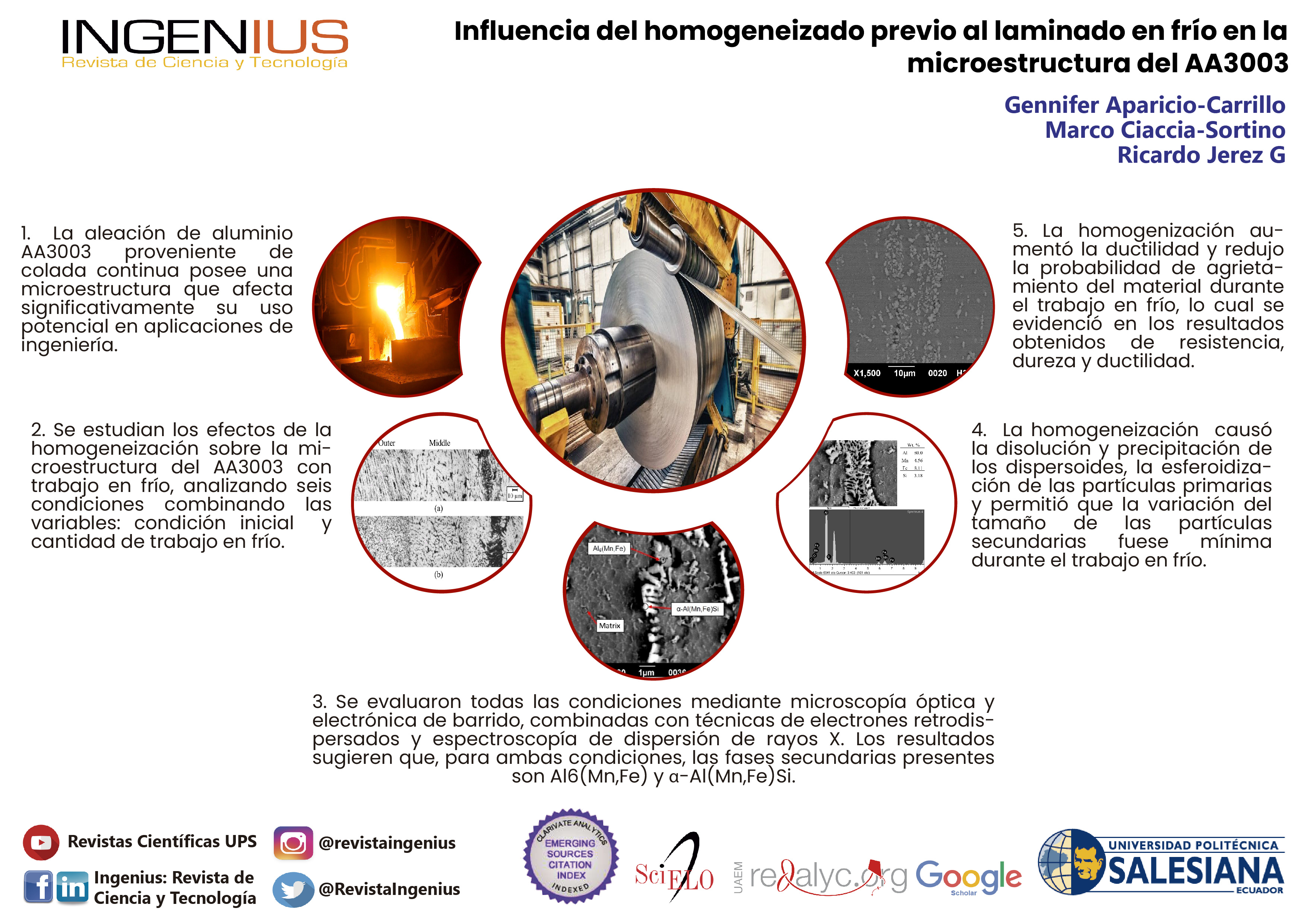
The aluminum alloy AA3003 produced by a direct chill continuous casting process has a microstructure that significantly affects its potential use in engineering applications. This work studies the effects of the homogenizing heat treatment on the microstructure of AA3003 with cold working. Six conditions were studied, combining the variables initial condition (with and without homogenizing) and amount of cold working. All conditions were evaluated by means of optical and scanning electron microscopy, in combination with backscattered electrons and energy dispersive X ray spectroscopy techniques. Results suggest that for both initial conditions, the secondary phases present are Al6(Mn,Fe) and ?-Al(Mn,Fe)Si, which vary in number, size, and shape. The homogenization caused the dissolution and precipitation of dispersoids, in addition to the spheroidization of primary particles, and minor variation of the size of secondary particles during cold working. Secondary phases are composed of primary and secondary particles, which differ in their Fe and Mn content, resulting in a lower Mn/Fe ratio for the primary particles (0,57 for the as?received condition and 0,80 for the homogenized condition), whereas the dispersoids have a higher Mn/Fe ratio (1,56 after the homogenization). Homogenization increased ductility and reduced the likelihood of cracking during cold working. This was evidenced by the results obtained for strength, hardness, and ductility.
Article Details
The Universidad Politécnica Salesiana of Ecuador preserves the copyrights of the published works and will favor the reuse of the works. The works are published in the electronic edition of the journal under a Creative Commons Attribution/Noncommercial-No Derivative Works 4.0 Ecuador license: they can be copied, used, disseminated, transmitted and publicly displayed.
The undersigned author partially transfers the copyrights of this work to the Universidad Politécnica Salesiana of Ecuador for printed editions.
It is also stated that they have respected the ethical principles of research and are free from any conflict of interest. The author(s) certify that this work has not been published, nor is it under consideration for publication in any other journal or editorial work.
The author (s) are responsible for their content and have contributed to the conception, design and completion of the work, analysis and interpretation of data, and to have participated in the writing of the text and its revisions, as well as in the approval of the version which is finally referred to as an attachment.
References
[2] M. Dehmas, E. Aeby-Gautier, P. Archambault, and M. Serriére, “Interaction between eutectic intermetallic particles and dispersoids in the 3003 aluminum alloy during homogenization treatments,” Metallurgical and Materials Transactions A, vol. 44, no. 2, pp. 1059–1073, Feb. 2013. [Online]. Available: https://doi.org/10.1007/s11661-012-1473-1
[3] Y. J. Li and L. Arnberg, “Quantitative study on the precipitation behavior of dispersoids in DC-cast AA3003 alloy during heating and homogenization,” Acta Materialia, vol. 51, no. 12, pp. 3415–3428, 2003. [Online]. Available: https://doi.org/10.1016/S1359-6454(03)00160-5
[4] Y. Li and L. Arnberg, Precipitation of Dispersoids in DC-Cast AA3103 Alloy during Heat Treatment. Grandfield J.F., Eskin D.G. (eds) Essential Readings in Light Metals. Springer, Cham, 2016. [Online]. Available: https://doi.org/10.1007/978-3-319-48228-6_129
[5] M. Velandia and B. Hidalgo, “Evolución estructural de la aleación AA-3003 sometida a tratamiento térmico de homogenización,” in 7th Latin American and Caribbean Conference for Engineering and Technology, San Cristóbal, Venezuela, 2009. [Online]. Available: https://bit.ly/3fofH1V
[6] H.-W. Huang and B.-L. Ou, “Evolution of precipitation during different homogenization treatments in a 3003 aluminum alloy,” Materials & Design, vol. 30, no. 7, pp. 2685–2692, 2009. [Online]. Available: https://doi.org/10.1016/j.matdes.2008.10.012
[7] Y. J. Li and L. Arnberg, “Precipitation of dispersoids in DC-cast 3003 alloy,” in Aluminium Alloys 2002 - ICAA8, ser. Materials Science Forum, vol. 396. Trans Tech Publications Ltd, 7 2002, pp. 875–880. [Online]. Available: https://doi.org/10.4028/www.scientific.net/MSF.396-402.875
[8] ASTM, ASTM E8 / E8M-21, Standard Test Methods for Tension Testing of Metallic Materials. ASTM International, West Conshohocken, 2004. [Online]. Available: http://doi.org/10.1520/E0008_E0008M-21
[9] ——, ASTM E3-01, Standard Practice for Preparation of Metallographic Specimens. ASTM International, West Conshohocken, 2001. [Online]. Available: http://doi.org/10.1520/E0003-01
[10] ——, ASTM E407-07(2015)e1, Standard Practice for Microetching Metals and Alloys. ASTM International, West Conshohocken, 1999. [Online]. Available: http://doi.org/10.1520/E0407-07R15E01
[11] M. Dehmas, P. Weisbecker, G. Geandier, P. Archambault, and E. Aeby-Gautier, “Experimental study of phase transformations in 3003 aluminium alloys during heating by in situ high energy X-ray synchrotron radiation,” Journal of Alloys and Compounds, vol. 400, no. 1, pp. 116–124, 2005. [Online]. Available: https://doi.org/10.1016/j.jallcom.2005.03.062
[12] G. E. Totten and D. S. MacKenzie, Handbook of Aluminum: Vol. 1: Physical Metallurgy and Processes. CRC Press, 2003. [Online]. Available: https://bit.ly/2SqMkTE
[13] ASTM, ASTM E384-17, Standard Test Method for Microindentation Hardness of Materials, ASTM International, West Conshohocken ed., 2002. [Online]. Available: http://doi.org/10.1520/E0384-17
[14] J. Pérez-Ilzarbe Uriz, J. Faustmann Salas, and A. Suárez Sanabria, “Recristalización de bandas de aluminio procedentes de colada continua, laminadas en frío,” Revista de Metalurgia, vol. 36, no. 6, pp. 435–451, 2000. [Online]. Available: https://dx.doi.org/10.3989/revmetalm.2000.v36.i6.594
[15] M. Slámová, M. Karlík, F. Robaut, P. Sláma, and M. Véron, “Differences in microstructure and texture of Al-Mg sheets produced by twin-roll continuous casting and by direct-chill casting,” Materials Characterization, vol. 49, no. 3, pp. 231–240, 2002. [Online]. Available: https://doi.org/10.1016/S1044-5803(03)00011-1
[16] Y. J. Li and L. Arnberg, “Evolution of eutectic intermetallic particles in DC-cast AA3003 alloy during heating and homogenization,” Materials Science and Engineering: A, vol. 347, no. 1, pp. 130–135, 2003. [Online]. Available: https://doi.org/10.1016/S0921-5093(02)00555-5
[17] M. Poková, M. Cieslar, and J. Lacaze, “Enhanced aw3003 aluminum alloys for heat exchangers,” in WDS’11 Proceedings of Contributed Papers, Part II, 2011, pp. 141–146. [Online]. Available: https://bit.ly/3bYehcj
[18] M. M. R. Jaradeh and T. Carlberg, “Solidification studies of 3003 aluminium alloys with Cu and Zr additions,” Journal of Materials Science & Technology, vol. 27, no. 7, pp. 615–627, 2011. [Online]. Available: https://doi.org/10.1016/S1005-0302(11)60116-3
[19] J. P. Martins, A. L. M. Carvalho, and A. F. Padilha, “Microstructure and texture assessment of Al-Mn-Fe-Si (3003) aluminum alloy produced by continuous and semicontinuous casting processes,” Journal of Materials Science, vol. 44, no. 11, pp. 2966–2976, Jun. 2009. [Online]. Available: https://doi.org/10.1007/s10853-009-3393-z
[20] T. Torres, R. Bisbala, S. Cameroa, and C. Llanos, “Estudio del efecto del tratamiento térmico de homogeneización en la microestructura y propiedades mecánicas de una aleación de aluminio AA8011,” Acta Microscópica, vol. 20, no. 2, pp. 165–173, 2011. [Online]. Available: https://bit.ly/3wCbT2K
[21] S. Y. Paredes-Dugarte and B. Hidalgo-Prada, “Micromecanismo de deformación durante la laminación en frío de la aleación comercial de aluminio 3003,” Suplemento de la Revista Latinoamericana de Metalurgia y Materiales, no. 2, pp. 778–781, 2009. [Online]. Available: https://bit.ly/2SpEYQh