

Influence of the Zinc Chromate coating on the corrosion of ASTM A-500 and galvanized A-500 steel exposed into a salt fog corrosion chamber
Article Sidebar
Main Article Content
Abstract
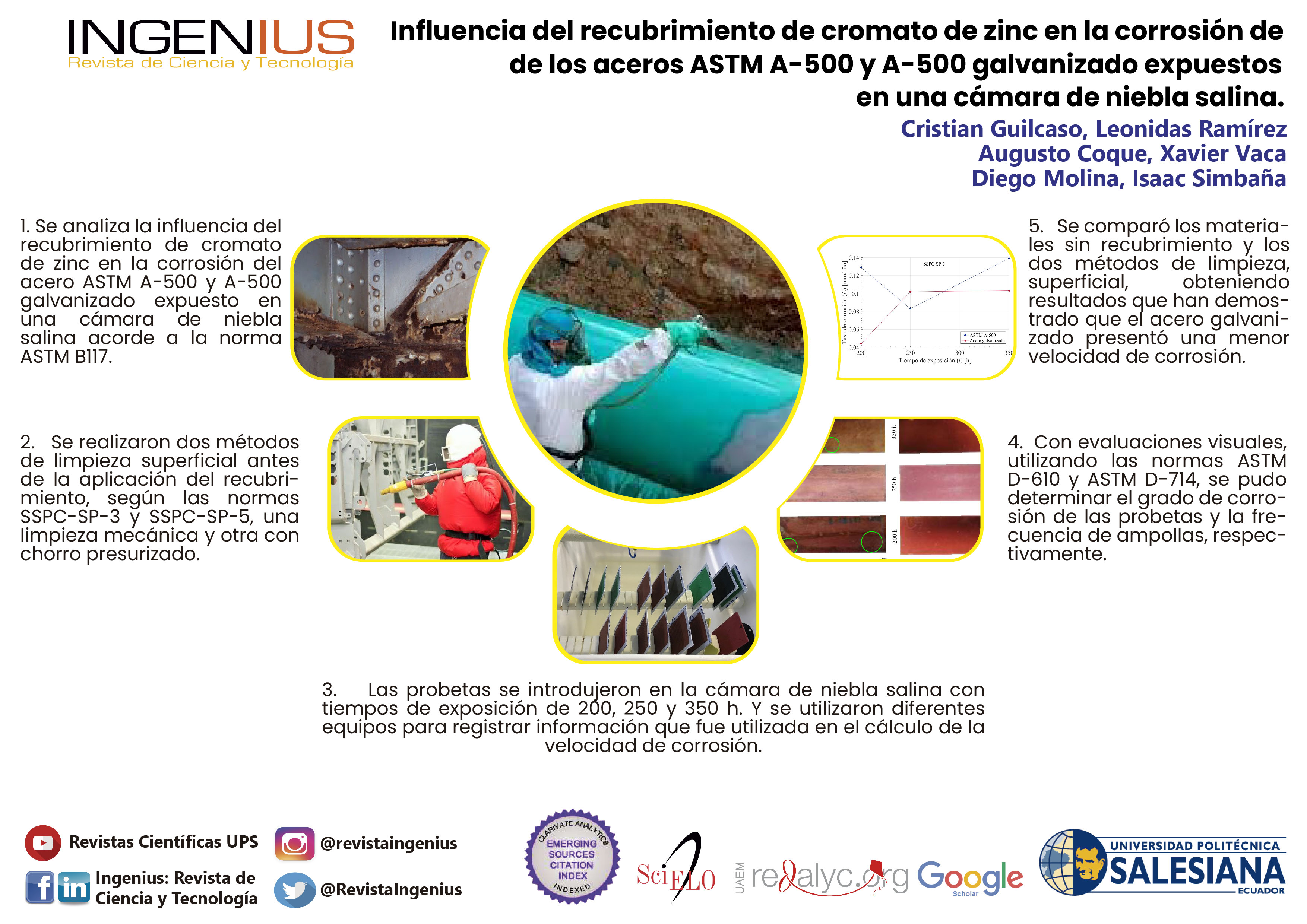
In this research work it has been analyzed the influence of the Zinc chromate coating on the corrosion of ASTM A-500 and galvanized A-500 steels exposed in a salt spray corrosion chamber, according to the ASTM B117 Standard. Two surface cleaning methods were used prior to applying the coating, considering the SSPC-SP-3 and SSP-SP-5 standards, namely a mechanical cleaning and a blast cleaning. The samples were put into the chamber with exposure times of 200, 250 and 350 h. Different equipment were used for recording the information that was used to calculate the corrosion rate. Through visual assessments according to the ASTM-D610 and ASTM D-714 standards, the corrosion degree and the blistering frequency, respectively, were determined. The materials without coating and coated after the two surface cleaning methods were compared. The results obtained have demonstrated that galvanized steel exhibited a lower corrosion rate.
Article Details
The Universidad Politécnica Salesiana of Ecuador preserves the copyrights of the published works and will favor the reuse of the works. The works are published in the electronic edition of the journal under a Creative Commons Attribution/Noncommercial-No Derivative Works 4.0 Ecuador license: they can be copied, used, disseminated, transmitted and publicly displayed.
The undersigned author partially transfers the copyrights of this work to the Universidad Politécnica Salesiana of Ecuador for printed editions.
It is also stated that they have respected the ethical principles of research and are free from any conflict of interest. The author(s) certify that this work has not been published, nor is it under consideration for publication in any other journal or editorial work.
The author (s) are responsible for their content and have contributed to the conception, design and completion of the work, analysis and interpretation of data, and to have participated in the writing of the text and its revisions, as well as in the approval of the version which is finally referred to as an attachment.
References
[2] K. B. Yu., G. Stradanchenko S., S. A. Yu., S. Garmider A., and B. Kalmykova Yu., “Effect of the bus bodywork on impact strength properties in roll-over,” ARPN Journal of Engineering and Applied Sciences, vol. 11, no. 17, pp. 10 205–10 208, 2016. [Online]. Available: https://bit.ly/3vsZf5F
[3] C. Cui, A. T. O. Lim, and J. Huang, “A cautionary note on graphene anti-corrosion coatings,” Nature Nanotechnology, vol. 12, no. 9, pp. 834–835, Sep. 2017. [Online]. Available: https://doi.org/10.1038/nnano.2017.187
[4] K. K. Toledo, H.-S. Kim, Y.-S. Jeong, and I.-T. Kim, “Residual compressive strength of short tubular steel columns with artificially fabricated local corrosion damage,” Materials, vol. 13, no. 4, 2020. [Online]. Available: https://doi.org/10.3390/ma13040813
[5] V. N. Tseluikin and A. A. Koreshkova, “Corrosion resistance of composite coatings based on zinc,” Chemical and Petroleum Engineering, vol. 52, no. 7, pp. 560–562, Nov. 2016. [Online]. Available: https://doi.org/10.1007/s10556-016-0232-3
[6] Q. Li, H. Lu, J. Cui, M. An, and D. Li, “Electrodeposition of nanocrystalline zinc on steel for enhanced resistance to corrosive wear,” Surface and Coatings Technology, vol. 304, pp. 567–573, 2016. [Online]. Available: https://doi.org/10.1016/j.surfcoat.2016.07.056
[7] H. Kania, M. Saternus, J. Kudláçek, and J. Svoboda, “Microstructure characterization and corrosion resistance of zinc coating obtained in a zn-alnibi galvanizing bath,” Coatings, vol. 10, no. 8, 2020. [Online]. Available: https://doi.org/10.3390/coatings10080758
[8] R. Vera, E. Cruz, M. Bagnara, R. Araya, R. Henríquez, A. Díaz-Gómez, and P. Rojas, “Evaluation of anticorrosive coatings on carbon steel in marine environments: Accelerated corrosion test and field exposure,” International Journal of Electrochemical Science, vol. 13, pp. 898–914, 2018. [Online]. Available: https://doi.org/10.20964/2018.01.66
[9] I. Stojanovic, A. Farkas, V. Alar, and N. Degiuli, “Evaluation of the corrosion protection of two underwater coating systems in a simulated marine environment,” Advances in Surface Engineering, vol. 71, no. 12, pp. 4330–4338, Dec. 2019. [Online]. Available: https://doi.org/10.1007/s11837-019-03669-4
[10] K. Goyal, H. Singh, and R. Bhatia, “Hot-corrosion behavior of Cr2O3-CNT-coated ASTM-SA213-T22 steel in a molten salt environment at 700circC,” International Journal of Minerals, Metallurgy, and Materials, vol. 26, no. 3, pp. 337–344, Mar. 2019. [Online]. Available: https://doi.org/10.1007/s12613-019-1742-8
[11] SSPC, “Sspc-sp-3, surface preparation specification: Power tool cleaining,” The Society for Protective Coatings, Tech. Rep., 2003. [Online]. Available: https://bit.ly/3u4JX6Z
[12] ——, “Sspc-sp-5, white metal blast cleaning,” The Society for Protective Coatings, Tech. Rep., 1999. [Online]. Available: https://bit.ly/3e3L2q1
[13] ASTM, “Astm b117 - 19 standard practice for operating salt spray (fog) apparatus,” ASTM International, West Conshohocken, PA, Tech. Rep., 2019. [Online]. Available: http://doi.org/10.1520/B0117-19
[14] ——, “Astm g1 - 03(2017)e1 standard practice for preparing, cleaning, and evaluating corrosion test specimens,” ASTM International, West Conshohocken, PA, Tech. Rep., 2017. [Online]. Available: http://doi.org/10.1520/G0001-03R17E01
[15] ——, “Astm d610 - 08(2019) standard practice for evaluating degree of rusting on painted steel surfaces,” ASTM International, West Conshohocken, PA, Tech. Rep., 2019. [Online]. Available: http://doi.org/10.1520/D0610-08R19
[16] ——, “Astm d714 - 02(2017) standard test method for evaluating degree of blistering of paints,” ASTM International, West Conshohocken, PA, Tech. Rep., 2017. [Online]. Available: http://doi.org/10.1520/D0714-02R17