

Evaluation of a fmcw radar as a teaching tool in the automotive and telecommunication engineering careers
Article Sidebar
Main Article Content
Abstract
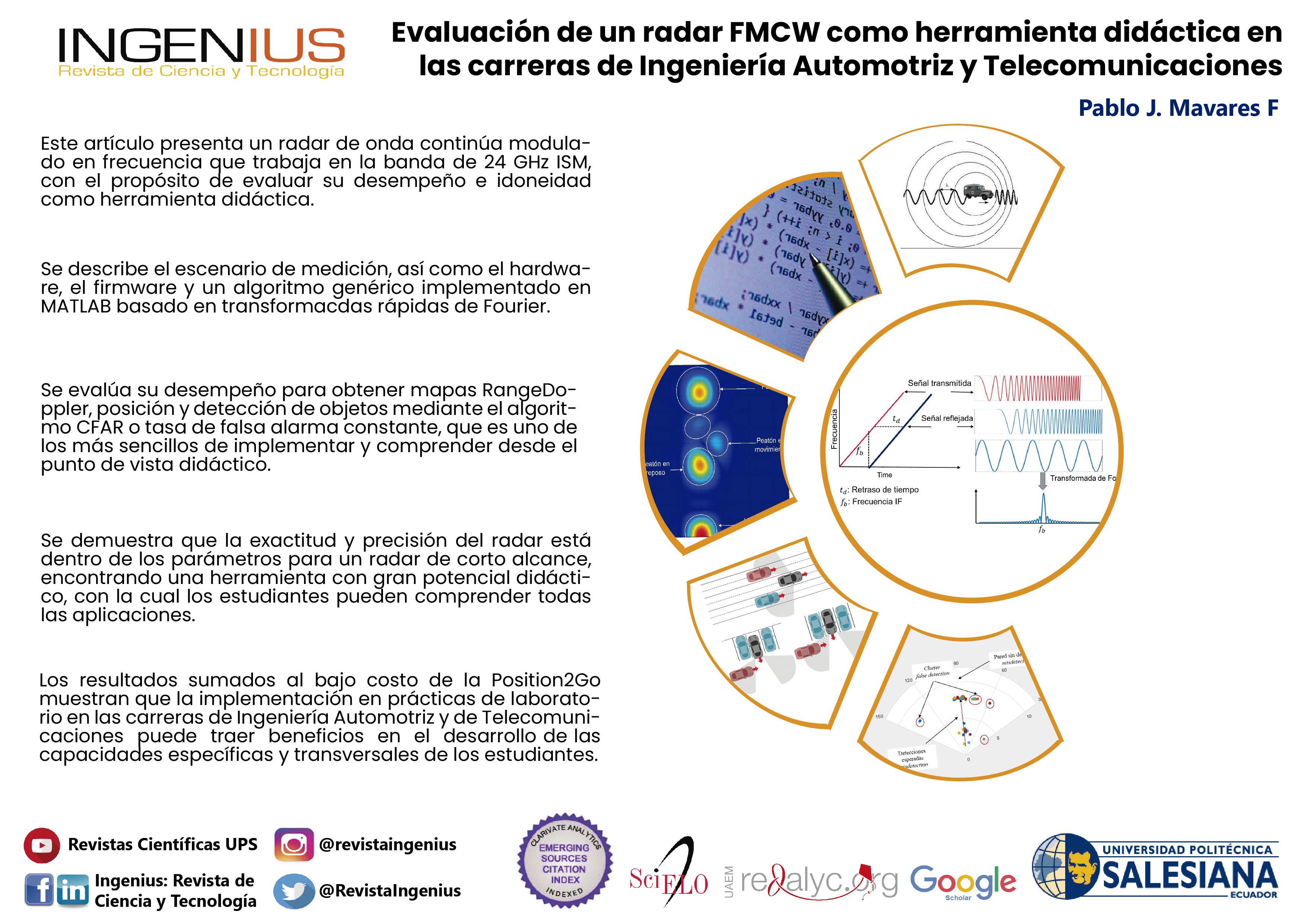
In recent decades, advanced driver-assistance systems (ADAS) have evolved to be available in much of the vehicles manufactured today; it is very important to keep teaching in this area up-to-date. This paper presents a frequency modulated continuous wave radar that works in the 24 GHz ISM band. The purpose of this work is to evaluate its performance and suitability to be used as a didactic tool in teaching in the automotive and telecommunications engineering careers with an emphasis on the mathematics and telecommunications subjects, under scenarios feasible to be found in university labs. For this purpose, the measurement scenario is described, as well as the hardware, firmware and a generic algorithm implemented in MATLAB based on fast Fourier transforms to obtain Range-Doppler maps that allow, in conjunction with the CFAR algorithm, to improve detection of objects when compared to the detection from a fixed level. The results presented demonstrate that the accuracy and precision of the radar are within the parameters for a short-range radar for vehicles, also finding a tool with great didactic potential with which students can understand today´s applications of mathematics in the field of telecommunications, especially in radars that serve ADAS systems.
Article Details
The Universidad Politécnica Salesiana of Ecuador preserves the copyrights of the published works and will favor the reuse of the works. The works are published in the electronic edition of the journal under a Creative Commons Attribution/Noncommercial-No Derivative Works 4.0 Ecuador license: they can be copied, used, disseminated, transmitted and publicly displayed.
The undersigned author partially transfers the copyrights of this work to the Universidad Politécnica Salesiana of Ecuador for printed editions.
It is also stated that they have respected the ethical principles of research and are free from any conflict of interest. The author(s) certify that this work has not been published, nor is it under consideration for publication in any other journal or editorial work.
The author (s) are responsible for their content and have contributed to the conception, design and completion of the work, analysis and interpretation of data, and to have participated in the writing of the text and its revisions, as well as in the approval of the version which is finally referred to as an attachment.
References
[2] J. Gamba, Radar Signal Processing for Autonomous Driving. Springer, 2020. [Online]. Available: https://bit.ly/3k8LP95
[3] C. Kumar and A. Killedar, mmWave Radar – ADAS Applications, 2015. [Online]. Available: https://bit.ly/3p6XeK9
[4] M. Nazir, “Automotive radar target detection using ambiguity function,” Ph.D. dissertation, University of Birmingham, 2016. [Online]. Available: https://bit.ly/3n2kI1g
[5] P. Pursula and V. Viikari, “Novel automotive radar applications,” in Millimetre Wave Days Proceedings, 2011, millimetre Wave Days 2011: 6th ESA Workshop on Millimetre-Wave Technology and Applications and 4th Global Symposium on Millimeter Waves; Conference date: 23-05-2011 Through 25-05-2011. [Online]. Available: https://bit.ly/2U5GZi0
[6] N. Bouhlel, S. Meric, C. Moullec, and C. Brousseau, “FMCW radar system for transponder identification,” Progress In Electromagnetics Research B, vol. 81, pp. 101–122, 2018. [Online]. Available: http://dx.doi.org/10.2528/PIERB18032007
[7] F. Ali and M. Vossiek, “Detection of weak moving targets based on 2-D range-doppler FMCW radar Fourier processing,” in German Microwave Conference Digest of Papers, 2010, pp. 214–217. [Online]. Available: https://bit.ly/3ni0lgE
[8] J. Kim, J. Chun, and S. Song, “Joint range and angle estimation for FMCW MIMO radar and its application,” 2018. [Online]. Available: https://bit.ly/2Uk63Ck
[9] B. Kim, Y. Jin, S. Kim, and J. Lee, “A lowcomplexity FMCW surveillance radar algorithm using two random beat signals,” Sensors (Basel), vol. 19, no. 3, p. 608, 2019. [Online]. Available: https://dx.doi.org/10.3390%2Fs19030608
[10] J. Svensson, “High resolution frequency estimation in an FMCW radar application,” 2018. [Online]. Available: https://bit.ly/2UjCXTs
[11] E. Guerrero-Menéndez, “Frequency-modulated continuous-wave radar in automotive applications,” 2018. [Online]. Available: https://bit.ly/3pp6slg
[12] M. D. Fontaine, Traffic Monitoring, 2009. [Online]. Available: https://bit.ly/36ne6nm
[13] V. Issakov, Microwave Circuits for 24 GHz Automotive Radar in Silicon-based Technologies. Springer, 2010. [Online]. Available: https://bit.ly/35nfJST
[14] C. Händel, H. Konttaniemi, and M. Autioniemi, State-of-the-Art Review on Automotive Radars and Passive Radar Reflectors Arctic Challenge research project. Lapland University of Applied Sciences, 2018. [Online]. Available: https://bit.ly/36u2yig
[15] Infineon, “Position2go software user manual,” Infineon, Tech. Rep., 2019. [Online]. Available: https://bit.ly/38ASmqE
[16] Mikusova, Miroslava, “Crash avoidance systems and collision safety devices for vehicle occupants,” MATEC Web Conf., vol. 107, p. 00024, 2017. [Online]. Available: https://doi.org/10.1051/matecconf/201710700024
[17] K. Ramasubramanian and K. Ramaiah, “Moving from legacy 24 ghz to state-of-the-art 77-ghz radar,” ATZelektronik worldwide, vol. 13, no. 3, pp. 46–49, Jun. 2018. [Online]. Available: https://doi.org/10.1007/s38314-018-0029-6
[18] J. M. Canino, V. Mena, J. Alonso, A. Ravelo, and E. García, “Prácticas de laboratorio en contextos de enseñanza-aprendizaje basados en competencias: dificultades y oportunidades,” in I Jornadas Iberoamericanas de Innovación Educativa en el ámbito de las TIC Las Palmas de Gran Canaria, 2014. [Online]. Available: https://bit.ly/2L2K01r
[19] S. Kocijancic, “Contemporary challenges in teaching electronics to stem teachers,” AIP Conference Proceedings, vol. 2043, no. 1, p. 020002, 2018. [Online]. Available: https://doi.org/10.1063/1.5080021
[20] M. V. Noroña M. and M. F. Gómez B., “Desarrollo e innovación de los sistemas mecatrónicos en un automóvil: una revisión,” Enfoque UTE, vol. 10, pp. 117–127, 03 2019. [Online]. Available: https://doi.org/10.29019/enfoqueute.v10n1.350
[21] Analog Devices, “Radar demonstration platform. evaluates radar chipset including the ADF5901, ADF5904 and ADF4159.” Analog Devices, Tech. Rep., 2019. [Online]. Available: https://bit.ly/2YRxHK8.
[22] Infineon, “Demo distance2go,” Infineon, Tech. Rep., 2020. [Online]. Available: https://bit.ly/35Rr7VI
[23] ——, “Demo position2go,” Infineon, Tech. Rep., 2020. [Online]. Available: https://bit.ly/2SUt6D8
[24] ——, “Infineon toolbox,” Infineon, Tech. Rep., 2020. [Online]. Available: https://bit.ly/3lrUbtJ
[25] ——, “Application notes,” Infineon, Tech. Rep., 2020. [Online]. Available: https://bit.ly/3bmpDnt
[26] ——, “MATLAB radar system API,” Infineon, Tech. Rep., 2020. [Online]. Available: https://bit.ly/38z2aS5
[27] CETECOM, “Testing services for various radar applications,” CETECOM, Tech. Rep., 2020. [Online]. Available: https://bit.ly/2UwRWK1
[28] MATLAB. (2020) Fourier transforms. [Online]. Available: https://bit.ly/2YPQzcz
[29] S. Hilbert. (2013) FFT zero padding. [Online]. Available: https://bit.ly/36HV2R5
[30] MATLAB. (2020) Constant false alarm rate (CFAR) detection. [Online]. Available: https://bit.ly/3dCuWRf.
[31] C. Will, P. Vaishnav, A. Chakraborty, and A. Santra, “Human target detection, tracking, and classification using 24-GHz FMCW radar,” IEEE Sensors Journal, vol. 19, no. 17, pp. 7283–7299, 2019. [Online]. Available: https://doi.org/10.1109/JSEN.2019.2914365
[32] M. Sepúlveda, “Las competencias transversales, base del aprendizaje para toda la vida,” Universidad EAN, 2017. [Online]. Available: https://bit.ly/2GYyDGg