

Analisys of the Efficiency of a Conventional Ventilated Brake Disc Compared to a Hyperventilated Disc Obtained by Machining
Article Sidebar
Main Article Content
Abstract
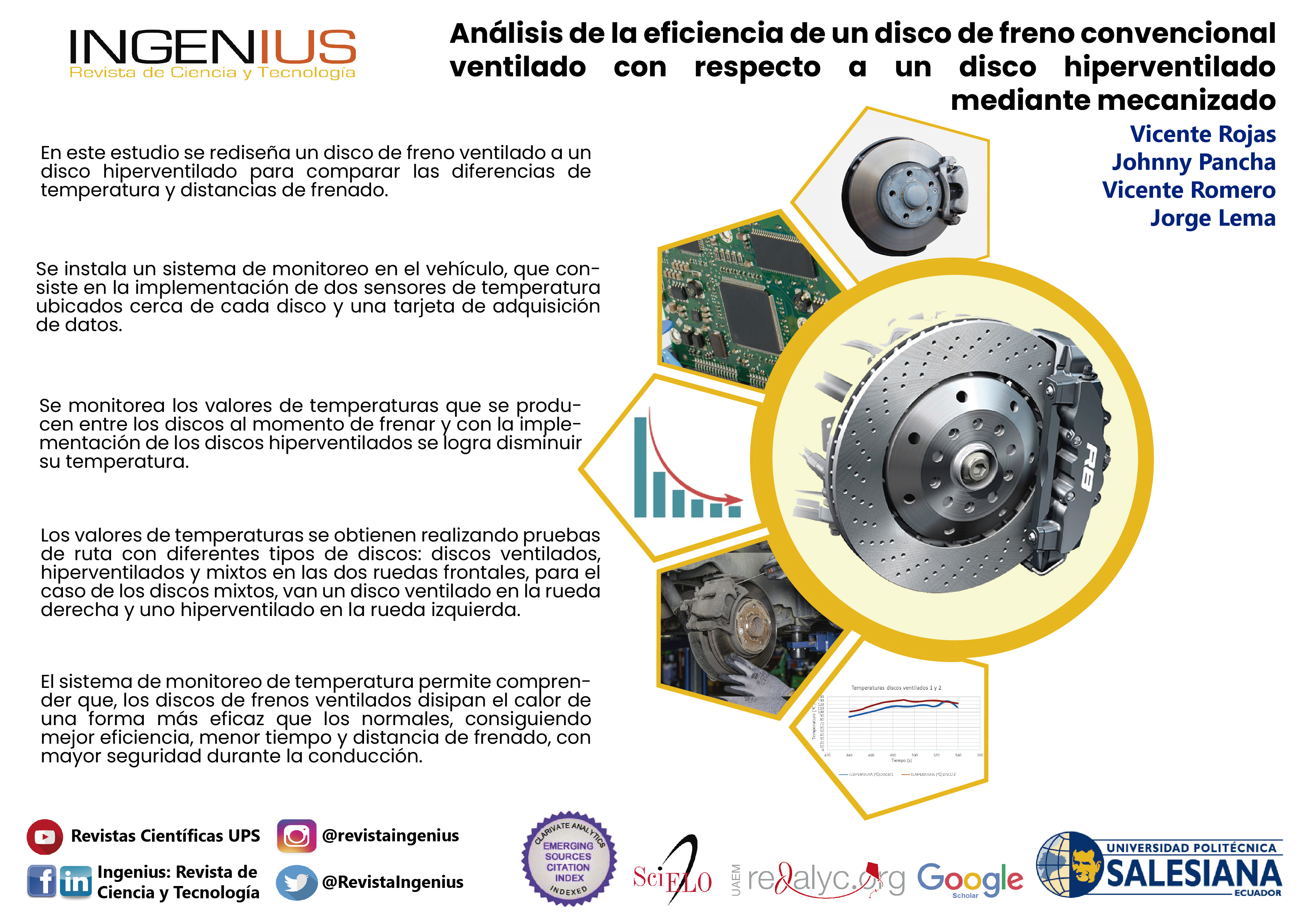
The objective of this study is to redesign a ventilated brake disc as a hyperventilated disc to compare the differences in temperature and brake distances; for this purpose, a monitoring system was installed in the vehicle which consisted of the implementation of two temperature sensors located near each disk and a data acquisition card. With the implementation of hyperventilated discs, the temperature generated by the braking friction could be reduced. The temperature values that occur between the discs when braking was monitored. To obtain the temperature values of the brake discs, road tests were conducted with different types of discs: ventilated discs on the two front wheels, hyperventilated discs on the two front wheels and mixed discs. In the mixed discs there is a ventilated disc on the right front wheel and a hyperventilated disc on the left front wheel. By displaying time data of the brake discs, it was possible to conclude that hyperventilated discs have better heat dissipation, since they have better ventilation. From all the results obtained on the route tests, it was possible to visualize the temperature behavior in the discs at the moment of braking and it was evidenced that hyperventilated discs tend to heat up less than normal discs, thus leading to a decrease in time and stopping distance.
Article Details
The Universidad Politécnica Salesiana of Ecuador preserves the copyrights of the published works and will favor the reuse of the works. The works are published in the electronic edition of the journal under a Creative Commons Attribution/Noncommercial-No Derivative Works 4.0 Ecuador license: they can be copied, used, disseminated, transmitted and publicly displayed.
The undersigned author partially transfers the copyrights of this work to the Universidad Politécnica Salesiana of Ecuador for printed editions.
It is also stated that they have respected the ethical principles of research and are free from any conflict of interest. The author(s) certify that this work has not been published, nor is it under consideration for publication in any other journal or editorial work.
The author (s) are responsible for their content and have contributed to the conception, design and completion of the work, analysis and interpretation of data, and to have participated in the writing of the text and its revisions, as well as in the approval of the version which is finally referred to as an attachment.
References
[2] R. García-León, M. Acosta, and E. Solano, “Análisis del comportamiento de los frenos de disco de los vehículos a partir de la aceleración del proceso de corrosión,” Tecnura, vol. 19, 07 2015. [Online]. Available: http://doi.org/10.14483/udistrital.jour.tecnura.2015.3.a04
[3] R. A. García-León, R. D. Echavez Díaz, and E. Flórez Solano, “Análisis termodinámico de un disco de freno automotriz con pilares de ventilación tipo NACA 66-209,” INGE CUC, vol. 14, no. 2, pp. 9–18, 2018. [Online]. Available: https://doi.org/10.17981/ingecuc.14.2.2018.01
[4] R. A. García León, “Estudio térmico en tres frenos de disco ventilados, utilizando el análisis de elementos finitos,” DYNA, vol. 84, no. 200, pp. 15–30, 2017. [Online]. Available: http://dx.doi.org/10.15446/dyna.v84n200.55663
[5] R. A. García León and E. N. Flórez Solano, “Estudio analítico de la transferencia de calor por convección que afectan a los frenos de disco ventilados,” Tecnura, vol. 20, pp. 15–30, mar. 2017. [Online]. Available: https://doi.org/10.14483/22487638.11676
[6] E. Águeda Casado, T. Gómez Morales, and J. Martín Navarro, Sistemas de transmisión de fuerzas y trenes de rodaje, ser. Ciclos formativos. Ediciones Paraninfo, 2012. [Online]. Available: https://bit.ly/2IcXcj6
[7] Aficionados a la Mecánica. (2020.) Ingeniería automotriz. [Online]. Available: https://bit.ly/3k7EzKC
[8] Y. Carranza Sánchez and R. Beltrán, “Transferencia de calor de estado inestable en forros para frenos,” 07 2003. [Online]. Available: https://bit.ly/354APFf
[9] F. Kreith, M. S. Bohn, and R. M. Manglik, Principios de Transferencia de Calor. Cengage Learning Editores, 2012. [Online]. Available: https://bit.ly/36dOPfh
[10] F. P. Incropera and D. P. DeWitt, Fundamentos de transferencia de calor. Pearson Educación, 1999. [Online]. Available: https://bit.ly/3ezzLw8
[11] Kashima University. (2016) Curso ingeniería automotriz. [Online]. Available: https://bit.ly/3mXaTRW
[12] D. Wenner, Manual práctico del cuidado y reparación del automóvil. México Continental, 1984. [Online]. Available: https://bit.ly/32jIr4P