

Analysis of the Hfo-1234ze as an Ecological Alternative In Domestic Refrigeration
Article Sidebar
Main Article Content
Abstract
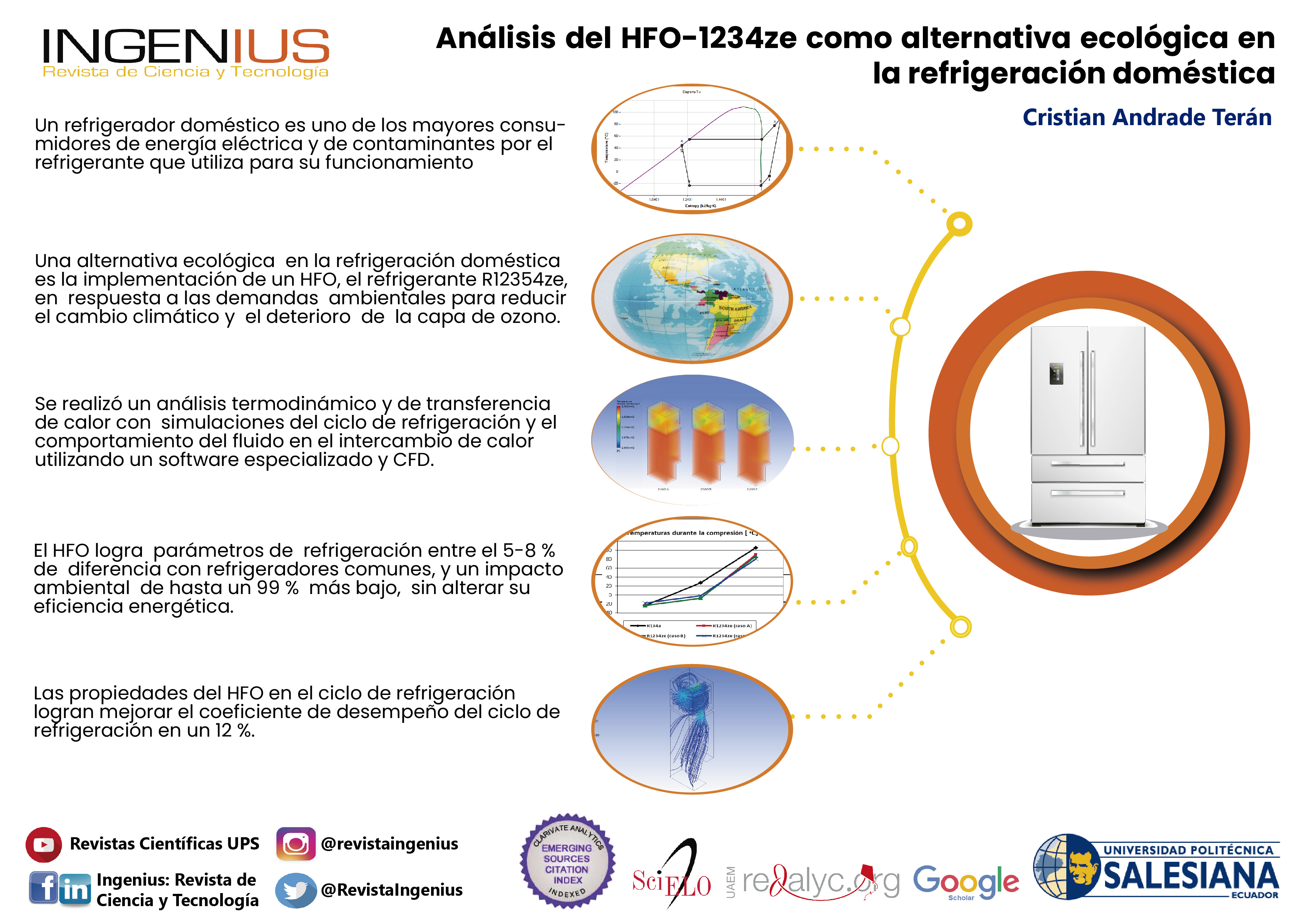
Food refrigeration is an essential process in homes, and thus a home refrigerator becomes an indispensable appliance. Being this one of the biggest consumers of electrical energy and contamination due to the refrigerant used for its operation, it is important to look for alternatives that improve this process. This study aims to implement the HFO, R12354ze as an ecological alternative in domestic refrigeration, in response to environmental demands to reduce climate change and deterioration of the ozone layer. Through a thermodynamic and heat transfer analysis, simulating the cooling cycle and the behavior of the fluid in heat exchange using specialized software and CFD, the HFO is presented as an acceptable alternative achieving cooling parameters which are between 5% and 8 % different from common refrigerators currently used, with an environmental cost up to 99% lower, without altering their energy efficiency. Taking advantage of the properties of the HFO, it is possible to improve the coefficient of performance of the cooling cycle by 12%.
Article Details
The Universidad Politécnica Salesiana of Ecuador preserves the copyrights of the published works and will favor the reuse of the works. The works are published in the electronic edition of the journal under a Creative Commons Attribution/Noncommercial-No Derivative Works 4.0 Ecuador license: they can be copied, used, disseminated, transmitted and publicly displayed.
The undersigned author partially transfers the copyrights of this work to the Universidad Politécnica Salesiana of Ecuador for printed editions.
It is also stated that they have respected the ethical principles of research and are free from any conflict of interest. The author(s) certify that this work has not been published, nor is it under consideration for publication in any other journal or editorial work.
The author (s) are responsible for their content and have contributed to the conception, design and completion of the work, analysis and interpretation of data, and to have participated in the writing of the text and its revisions, as well as in the approval of the version which is finally referred to as an attachment.
References
[2] D. Fahey, P. A. Newman, J. A. Pyle, B. Safari, M. P. Chipperfield, D. Karoly, D. E. Kinnison, M. Ko, M. Santee, and S. J. Doherty, Scientific Assessment of Ozone Depletion: 2018, Global Ozone Research and Monitoring Project-Report No. 58. World Meteorological Organization, 01 2018. [Online]. Available: https://bit.ly/3oil19H
[3] L. Höglund-Isaksson, P. Purohit, M. Amann, I. Bertok, P. Rafaj, W. Schöpp, and J. Borken-Kleefeld, “Cost estimates of the kigali amendment to phase-down hydrofluorocarbons,” Environmental Science & Policy, vol. 75, pp. 138–147, 2017. [Online]. Available: https://doi.org/10.1016/j.envsci.2017.05.006
[4] A. Mota-Babiloni, J. Navarro-Esbrí, A. Barragán, F. Molés, and B. Peris, “Drop-in energy performance evaluation of r1234yf and r1234ze(e) in a vapor compression system as r134a replacements,” Applied Thermal Engineering, vol. 71, no. 1, pp. 259–265, 2014. [Online]. Available: https://doi.org/10.1016/j.applthermaleng.2014.06.056
[5] A. Yataganbaba, A. Kilicarslan, and I. Kurtbas, “Exergy analysis of r1234yf and r1234ze as r134a replacements in a two evaporator vapour compression refrigeration system,” International Journal of Refrigeration, vol. 60, pp. 26–37, 2015. [Online]. Available: https://doi.org/10.1016/j.ijrefrig.2015.08.010
[6] M. O. McLinden, A. F. Kazakov, J. Steven Brown, and P. A. Domanski, “A thermodynamic analysis of refrigerants: Possibilities and tradeoffs for Low-GWP refrigerants,” International Journal of Refrigeration, vol. 38, pp. 80–92, 2014. [Online]. Available: https://doi.org/10.1016/j.ijrefrig.2013.09.032
[7] D. Sánchez, I. Arauzo, J. Catalán Gil, R. Cabello, R. Doménech, and E. Torrella, “Evaluación energética de una instalación frigorífica empleando refrigerantes de bajo GWP,” in CYTEF 2016 – VIII Congreso Ibérico | VI Congreso Iberoamericano de las Ciencias y Técnicas del Frío Coimbra-Portugal, 3-6 mayo, 2016, 05 2016. [Online]. Available: https://bit.ly/31EdI29
[8] W. C. Whitman and W. M. Jonhson, Tecnología de la refrigeración y aire acondicionado Tomo II. Editorial Paraninfo, 2000. [Online]. Available: https://bit.ly/34u3xiN
[9] N. Jara and C. Isaza-Roldan, “Análisis comparativo de sistemas de refrigeración doméstica utilizando refrigerantes R600a y R134a,” Revista I+T+C: Investigación, Tecnología y Ciencia, vol. 1, pp. 7–15, 08 2015. [Online]. Available: https://bit.ly/2TnGIXo
[10] GASSERVEI, “Ficha técnica R-1234ze,” GASSERVEI, Tech. Rep., 2020. [Online]. Available: https://bit.ly/3dUDJ2e
[11] Honeywell, “The environmental alternative to traditional refrigerants. solstice ze refrigerant (HFO-1234ze (E)),” Honeywell, Tech. Rep., 2018. [Online]. Available: https://bit.ly/3mhCY6d
[12] N. A. Lai, “Equations of state for HFO-1234ze(E) and their application in the study on refrigeration cycle,” International Journal of Refrigeration, vol. 43, pp. 194–202, 2014. [Online]. Available: https://doi.org/10.1016/j.ijrefrig.2013.11.011
[13] E. W. Lemmon, I. H. Bell, M. L. Huber, and M. O. McLinden, REFPROP Documentation Release 10.0. National Institute of Standards and Technology (NIST), 2018. [Online]. Available: https://bit.ly/3omeSct
[14] K. A. Klein and F. L. Alvarado, EES-Engineering Equation Solver. Version 6.648 ND, F-Chart Software, Middleton, 2004.
[15] G. A. Longo, S. Mancin, G. Righetti, and C. Zilio, “R1234yf and R1234ze(e) as environmentally friendly replacements of R134a: Assessing flow boiling on an experimental basis,” International Journal of Refrigeration,
vol. 108, pp. 336–346, 2019. [Online]. Available: https://doi.org/10.1016/j.ijrefrig.2019.09.008
[16] D. Sánchez, R. Cabello, R. Llopis, I. Arauzo, J. Catalán-Gil, and E. Torrella, “Energy performance evaluation of R1234yf, R1234ze(e), R600a, R290 and R152a as low-GWP R134a alternatives,” International Journal of Refrigeration, vol. 74, pp. 269–282, 2017. [Online]. Available: https://doi.org/10.1016/j.ijrefrig.2016.09.020
[17] ANSYS, ANSYS Fluent Theory Guide. SAS IP, Inc., 2013. [Online]. Available: https://bit.ly/3jk7GtC
[18] H. Benjumea, C. Isaza-Roldan, S. Rio, N. Jara, and J. Ospina, “Simulación del flujo de aire al interior de un refrigerador doméstico nofrost,” in VII Congreso Ibérico de Ciencias y Técnicas del Frío, 06 2014. [Online]. Available: https://bit.ly/2TnHwvE