|
Scientific Paper / Artículo Científico |
|
|
|
|
https://doi.org/10.17163/ings.n35.2026.01 |
|
|
|
pISSN: 1390-650X / eISSN: 1390-860X |
|
|
OPTIMIZATION OF ENERGY CONSUMPTION IN OIL REMOTE CAMPS THROUGH ENERGY MANAGEMENT TECHNOLOGIES |
||
|
OPTIMIZACIÓN DEL CONSUMO ENERGÉTICO EN CAMPAMENTOS REMOTOS PETROLEROS MEDIANTE TECNOLOGÍAS DE GESTIÓN ENERGÉTICA |
||


|
Edwin Illescas1 Miguel
Alberto Dávila-Sacoto1,* |

|
Received: 02-04-2025, Received after review: 21-05-2025, Accepted: 29-09-2025, Published: 01-01-2026 |
|
Abstract |
Resumen |
|
Optimizing resource use in remote operational fields is a key strategy for enhancing efficiency and reducing operating costs. This study adopted a descriptive– experimental design with a quantitative orientation to analyze the energy consumption of a remote oil transportation camp, utilizing historical records collected since 2021. The primary objective was to achieve an energy consumption reduction of 15–30%. Using RETScreen, improvements in energy systems were simulated, resulting in an initial annual electricity consumption of 271,143 kWh and associated costs of USD 27,454. With the proposed photovoltaic system, designed to optimize energy use through advanced energy management technologies, annual consumption decreased to 185,878 kWh/year, substantially reducing dependence on the national interconnected grid and on polluting energy sources. Energy efficiency improved by 14.3% in air-conditioning systems and by 38.6% in electrical systems such as pumps, compressors, and lighting, resulting in an overall average energy savings of 30.9%. In terms of environmental impact, CO2 emissions were reduced from 58.8 tCO2 to 40.7 tCO2, equivalent to the carbon sequestration of approximately 1.7 hectares of forest. The estimated return on investment is 10.7 years. These results demonstrate the technical, economic, and environmental feasibility of implementing energy-efficiency technologies to enhance sustainability in remote oilfield operations. |
Optimizar los recursos en campos remotos es un criterio fundamental para la eficiencia y la reducción de costos operativos. El estudio tuvo un enfoque descriptivo-experimental, con orientación cuantitativa, en el que se analizó el consumo energético de un campamento remoto de transporte de petróleo, utilizando registros históricos desde 2021. El objetivo principal fue la reducción del consumo energético en un rango del 15% al 30%. Mediante el uso de RETScreen se simularon mejoras en los sistemas energéticos, obteniéndose como resultado un consumo eléctrico anual de 271 148 kWh/año, con gastos asociados de USD 27 454. Con la propuesta fotovoltaica, orientada a optimizar el consumo mediante tecnología de gestión energética, el consumo se redujo a 185 878 kWh/año, disminuyendo significativamente la dependencia del Sistema Nacional Interconectado y el uso de fuentes contaminantes. La eficiencia en sistemas de climatización mejoró en un 14.3%, mientras que en los sistemas eléctricos —bombas, compresores e iluminación— se alcanzó una mejora significativa de 38.6%, con un ahorro promedio de 30.9%. Respecto a las emisiones, estas se redujeron de 58.8 tCO2 a 40.7 tCO2, lo que equivale a la absorción de 1.7 hectáreas de bosque con un retorno de inversión estimado en 10.7 años. En conclusión, este proyecto resulta viable desde el punto de vista de la aplicación de tecnologías de eficiencia energética, al incorporar mejoras técnicas que consolidan una solución económicamente rentable y ambientalmente sostenible. |
|
Keywords: remote oil camps, energy management, energy optimization, RETScreen, photovoltaic systems, management technologies. |
Palabras clave: campamentos remotos petroleros, gestión energética, optimización energética, RETScreen, sistemas fotovoltaicos, tecnologías de gestión. |
|
1,*Pontificia Universidad Católica, Sede Esmeraldas,
Ecuador. Corresponding author ✉: madavila@pucese.edu.ec.
Suggested citation: E. Illescas, E. Laz, M.R. Nevarez Toledo and M.A. Dávila-Sacoto. “Optimization of energy consumption in oil remote camps through energy management technologies,” Ingenius, Revista de Ciencia y Tecnología, N.◦ 35, pp. 9-20, 2026, doi: https://doi.org/10.17163/ings.n35.2026.01. |

|
1. Introduction
The dynamism of the oil industry exerts a substantial influence on global economic and social development. Petroleum resources account for approximately one-third of the world’s primary energy supply and contribute around 2.5% to the global GDP [1]. Consequently, crude oil transportation represents a critical component of the fossil fuel supply chain. Remote operational camps that support this infrastructure face persistent challenges related to energy efficiency, operational autonomy, and environmental sustainability. Most of these facilities rely on conventional power generation systems with high emission factors, which drive operating costs and significantly increasetheir carbon footprint. The development of intelligent energy management technologies entails the integration of artificial intelligence (AI) and machine learning algorithms into SCADA and BEMS (Building Energy Management Systems) platforms [2, 3]. These systems enable the analysis of consumption patterns, the prediction of load curves, and the real-time optimization of energy use [4, 5], allowing them to adapt to stochastic disturbances such as demand fluctuations and variability in renewable energy sources [6]. In parallel, demand response programs (DRP) incentivize users to modify their consumption in response to network signals, such as elevated prices or targeted economicincentives [7, 8]. Following these principles, Energy Management Systems (EnMS), aligned with the International Organization for Standardization ISO 50001 standard, constitute an effective strategy for enhancing corporate energy efficiency and improving operational performance [9, 10]. These systems rely on the implementation of progressive energy policies, clearly defined objectives, and targeted actions aimed at optimizing energy performance [11]. The sustained growth in global energy consumption, along with the environmental impacts associated with conventional energy sources, has generated increasing international interest in more efficient energy management strategies. In this context, RETScreen Expert, developed by Natural Resources Canada, offers a powerful platform for assessing the technical and economic feasibility of energy projects. It enables the modeling of electrical and thermal systems and the calculation of key performance indicators such as energy savings, emission reductions, and economic returns. Collectively, these capabilities provide a solid foundation for data-driven decision-making to support an effective energy transition [12]. Among the renewable energy solutions that can be managed through the RET Screen platform, photovoltaic solar technology stands out for its ability to convert direct solar radiation into electricity using silicon-based panels. |
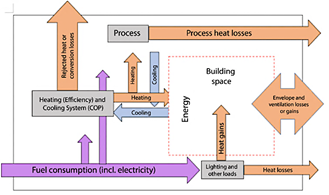
This technology is distinguished by its versatility, low maintenance requirements, and long service life (25–30 years). It produces no greenhouse gas (GHG) emissions during operation, and its successful implementation depends on prior assessments of solar irradiance, panel tilt, and overall system efficiency [13, 14]. In the lighting sector, LED luminaires powered by renewable energy sources represent an efficient and sustainable alternative, as they offer extended service life, lower emissions, and improved energy performance [15]. Although the initial investment cost is relatively high, a thorough techno-economic analysis can justify the expenditure by evaluating factors such as lighting quality, illuminance level (lux), and visual comfort [16]. Air conditioning systems account for a substantial share of energy consumption in buildings, and their optimization requires enhancing the coefficient of performance (COP) [17]. These systems contribute more than 34% of total energy demand and approximately 37% of CO2 emissions [18], underscoring the need for decarbonization through reduced reliance on fossil fuels and hydrofluorocarbons (HFCs) [19]. The International Organization for Standardization ISO 50001:2018 standard, specifically Clause 6, establishes a framework for the implementation and continuous improvement of Energy Management Systems (EnMS), enabling reductions in energy consumption, operating costs, and greenhouse gas emissions, as well as the optimization of overall energy performance [20]. In this context, oilfield camps depend primarily on diesel and natural gas: the former entails high costs and considerable environmental impact, whereas the latter, although cleaner, is constrained by logistical challenges. This energy profile reflects the broader balance observed in building energy systems. Figure 1 illustrates the fundamental processes common to both air-conditioning systems and lighting installations.
Figure 1. Energy balance for building systems |
|
Energy use, encompassing both fuels and electricity, depends on the primary energy source and the performance of the heating and cooling system, which is typically quantified through the coefficient of performance (COP). A considerable share of this energy is ultimately dissipated as waste heat. Thermal energy is transferred indoors, where it interacts with factors such as solar radiation, artificial lighting, and the operation of electrical equipment, resulting in internal heat gains. Conversely, thermal losses occur through the building envelope and ventilation, thereby increasing overall energy demand. Industrial processes also contribute heat to the indoor environment; however, a portion of this energy is lost to the exterior, thereby reducing overall system efficiency. Similarly, heat losses through the roof and ventilation increase the building’s thermal load and, consequently, its energy consumption. In this context, optimizing energy consumption through advanced energy management technologies constitutes a key strategy for mitigating the environmental impacts associated with the use of nonrenewable energy sources, particularly in remote operational camps [21]. This study examines the implementation of the RETScreen platform as a tool for enhancing energy efficiency and integrating renewable energy systems. |
This research focuses on maximizing energy-use efficiency in oilfield camps through a comprehensive assessment of current consumption patterns, feasibility analysis using RETScreen, and the formulation of renewable energy solutions and short-term operational measures designed to enhance performance and reduce overall energy demand.
2. Materials and Methods
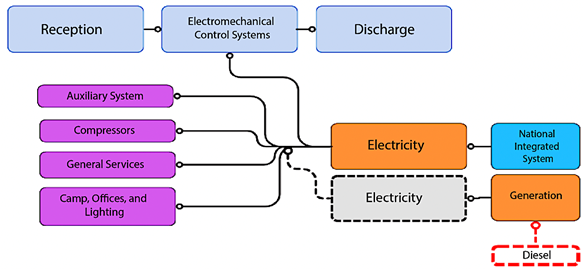
This study employs a descriptive–experimental design with a quantitative approach. Historical records of energy consumption for the 2021–2022 period were analyzed, encompassing 24 measurements collected at a crude oil transportation facility. The analysis compares a baseline scenario with an optimized case to assess the impact of energy efficiency measures. The RETScreen Expert platform is employed to simulate operating conditions, model subsystems, and evaluate the feasibility of different energy efficiency measures. The analysis focuses on lighting, general services, and air-conditioning systems. Figure 2 illustrates the energy flow and the supply sources considered in the study. |
|
Figure 2. Schematic representation of electrical energy flow in the camp areas |
|
The energy is supplied by the National Interconnected System (SNI), which feeds the fire protection systems, compressors, dining hall, offices, and camp lighting. The entire process is regulated by an electromechanical control system equipped with valves. As a backup, diesel generators are connected to the same network to provide power in the event of failures, ensuring operational continuity. The energy performance assessment is structured around three methodological axes:
· Collection and analysis of operational data. · Identification of improvement opportunities and strategic planning. · Implementation and monitoring of results.
For the initial stage of model configuration, data on the camp’s average energy consumption were entered, with particular emphasis on cooking, air conditioning, |
lighting, fluid compression systems, and energy-related costs. Additionally, the site’s geographical characteristics, including latitude, longitude, climate zone, and terrain attributes, were incorporated into the analysis usingthe following georeferenced data:
· N 0° 58’ 22.268", O 79° 40’ 51.536" · 0.9728521511737187, –79.68098222443405
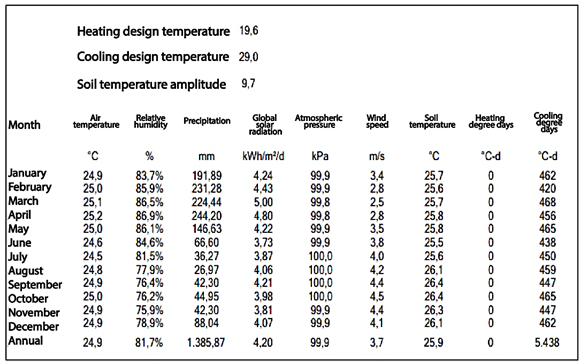
To strengthen the proposal for incorporating renewable energy systems, environmental variables, including air temperature, relative humidity, precipitation, atmospheric pressure, and soil temperature, were incorporated into the model. These parameters were integrated into the analysis to assess the thermal and energy performance of both conventional and renewable systems under the site’s specific environmental conditions, as shown in Figure 3. |
|
Figure 3. Monthly meteorological parameters for the proposed geolocation in 2025, based on data from NASA. |
|
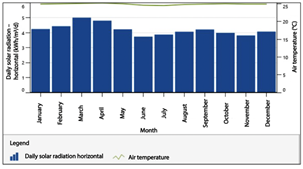
Through georeferencing, a graph of meteorological data representing monthly solar radiation and air temperature over a one-year period was generated, as shown in Figure 4. |
Figure 4. Comparison of monthly solar radiation and air temperature in 2025, based on data from NASA. |
|
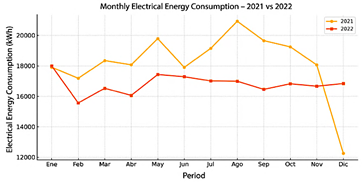
Additionally, electrical consumption data for the 2021–2022 period were collected. The analysis performed in RETScreen implemented demand management, energy storage, and optimization strategies in accordance with the modules structured within the software, aiming to reduce energy losses and improve cost efficiency. As a baseline reference, Figure 5 illustrates the comparison of monthly energy consumption (kWh) between2021 and 2022. In 2021, total energy consumption reached 271,148 kWh (51.86%), whereas in 2022 it decreased to 251,622 kWh (48.04%). This reduction is attributed to social mobilizations that temporarily limited the operation of the camps.
Figure 5. Comparison of the camp’s total energy consumption between 2021 and 2022
|
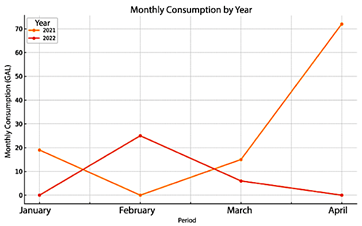
Regarding fossil fuel consumption, records are available only for January–April 2021 and January–March 2022, as shown in Figure 6. These datasets enabled the analysis of the thermal impact associated with autonomous electricity generation, as well as its correlation with the efficiency of the evaluated energy system.
Figure 6. Comparison of fuel consumption during the 2021–2022 period.
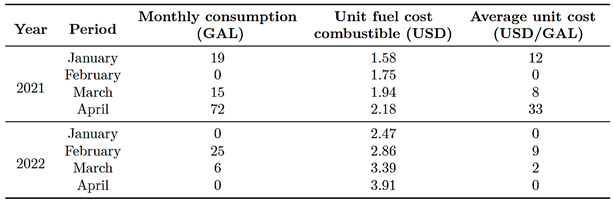
Fuel consumption reflects fluctuations in the oil market, which influence costs during the analyzed period and constitute a key parameter for estimating the expenditures associated with fuel use. Table 1 presents the unit fuel prices and their variation over time. |
|
Table 1. Fuel consumption and cost under the baseline scenario
|
|
The reduction in SNI consumption was offset by fossil fuel generation. The camp’s electrical data were entered into the software to establish the baseline scenario, considering generator systems, pumps, compressors, lighting, air-conditioning units, and other auxiliary equipment.
|
The energy demand (ED) was calculated as power × hours/day × days/year, adjusted for system efficiency, as expressed in Equation (1).
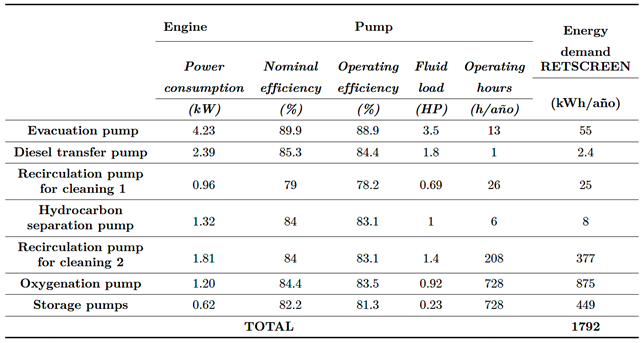
The energy recording began with the loads associated with the camp’s pumping system, as detailed in Table 2. |

|
Table 2. Recorded data and energy performance analysis of the pumping systems in the camp
|
|
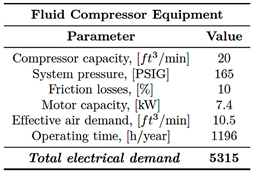
The annual energy consumption was 1,792 kWh, calculated based on operating hours and pump power. Historical records reported a value of 1,790.89 kWh, thereby confirming the reliability of the established energy baseline. In the RETScreen simulation, an air system with a screw compressor was modeled and configured as compressed air equipment within the software, as detailed in Table 3.
Table 3. Recorded data for electrical equipment
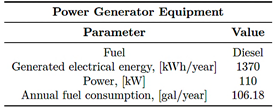
After recording the fluid compressor data, the electric generator was incorporated into the integrated energy system, whose technical characteristics are detailed in Table 4. |
Table 4. Recorded data for power generation equipment
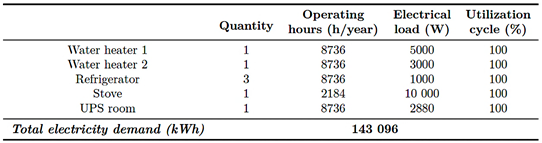
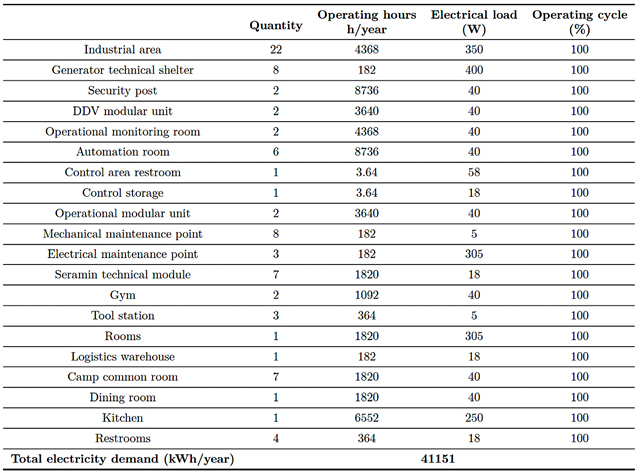
After recording the compressor, additional electrical loads were incorporated, including the water heating, refrigeration, kitchen, and computer systems, to complete the comprehensive modeling of electrical demand. This process was systematized by considering the connected load (kW), annual operating hours, and total system demand (kWh), in accordance with the guidelines of the RETScreen Expert electrical end-use module, see table 5. The lighting system modeling was conducted by entering data according to the camp’s functional areas, following the same procedure applied to the general electrical loads. Because these components have a significant energy impact on overall energy consumption and exhibit substantial variability, they were parameterized in detail in RETScreen. Table 6 presents the total electrical demand associated with this category. |
|
Table 5. Recorded data for electrical equipment in the kitchen area
Table 6. Electrical energy demand of the camp’s luminaires, as provided by RETScreen
|
|
For the registration of air conditioning systems, an average coefficient of performance (COP) of 3 was considered, corresponding to the three air conditioning units. These systems were subsequently integrated into the RETScreen platform, assuming a total cooling thermal load of 93,500 BTU/h, a utilization cycle of 100%, and 8,736 annual operating hours. The analysis determined an annual energy demand of 79,795 kWh, corresponding to the expected consumption of the air conditioning subsystem.
|
3. Results and Discussion
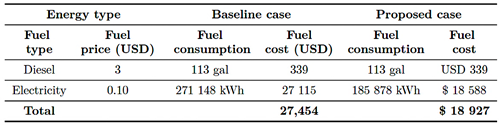
Table 7 summarizes the energy balance, indicating a total fuel consumption of 113 gal/year (equivalent to 4,557 kWh/year) and a total energy consumption of 271,148 kWh/year. The associated annual costs are USD 339 for diesel and USD 27,115 for electricity, assuming an average diesel price of USD 3/gal and an electricity rate of USD 0.10/kWh. |
|
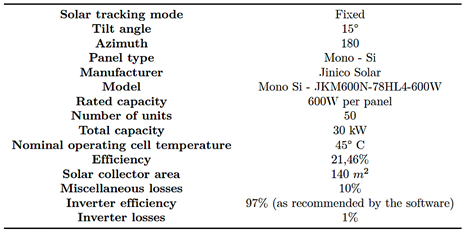
In this case, it was determined that reducing energy consumption in the oil transportation camp requires the implementation of a photovoltaic system designed to achieve savings of 15–30% of the camp’s total energy demand. Accordingly, a fixed system was selected, |
consisting of 50 panels with an individual capacity of 600 W, yielding an approximate total power of 30 kW after accounting for panel and inverter losses. The remaining characteristics are presented in Table 8. |
|
Table 7. Annual fuel and electricity consumption and associated costs in the baseline and proposed cases
Table 8. Components and key indicators of the photovoltaic system analyzed in RETScreen
|
|
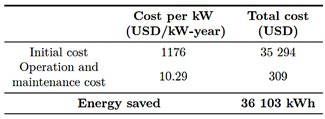
The premise established in this analysis is that, to maintain a constant consumption of the energy generated by the photovoltaic system, the tilt angle must be set at 15°. Regarding the azimuth orientation, it should be aligned according to the corresponding hemisphere. In this case, since Esmeraldas (Ecuador) is located in the Northern Hemisphere, the optimal orientation is toward the south, corresponding to an azimuth angle of 180°. The premise also establishes that the initial, operating, and maintenance costs, along with the camp’s energy savings, are summarized in Table 9.
Table 9. Installation and operation–maintenance costs and annual energy savings of the photovoltaic system
|
It should be noted that the components were selected based on the initial premise of reducing energy dependence on both the National Interconnected System (SNI) and conventional generation sources, such as diesel generators, by 15–30%. Consequently, all parameters were automatically calculated by RETScreen, which provided recommendations regarding suppliers, models, capacity, efficiency, and losses, as well as economic indicators such as the panel cost per kilowattand the annual operation and maintenance cost.
3.1.Energy Consumption Optimization Measures
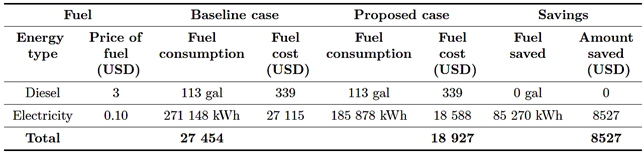
Focusing on the energy savings within the camp’s energy system, a direct relationship was established between the input data and the incorporation of the photovoltaic system as a key element. Through this integration, the primary objective of the study was achieved, reducing overall energy consumption by 15–30% through the application of optimization principles. These results are summarizedin Table 10. |
|
Table 11 indicates that, in the baseline case, 113 gallons of diesel (USD 339) and 271,148 kWh/year of electricity (USD 27,454) were consumed. In the proposed case, diesel consumption remains unchanged, while electricity consumption decreases to 185,878 kWh/year |
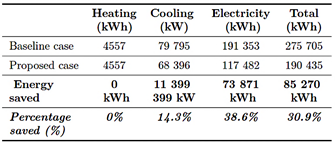
(USD 18,588), yielding energy savings of 85,270 kWh (31%) as a result of the photovoltaic system implementation. The distribution of savings by subsystem (heating, cooling, and electricity) is detailed in Table 11. |
|
Table 10. Electricity and fuel savings in the camp
|
|
Table 11. Energy and percentage savings for each subsystem
With the incorporation of the photovoltaic system, the cooling subsystem achieves 14.3% energy savings, while the electrical subsystem (pumps, compressors, and lighting) achieves 38.6%, resulting in an overall average reduction of 30.9%. By eliminating dependence on the SNI and diesel generators, the economic benefit is substantial, with an estimated return on investment of 10.7 years. Figure 7 compares the results forboth cases.
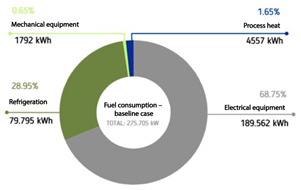
Figure 7. Baseline energy consumption by fuel type for the different equipment categories |
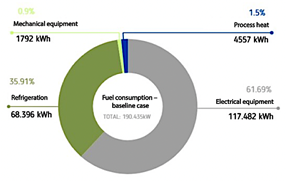
Electrical equipment, such as generators, accounts for the largest share of fuel consumption in the camp facilities, followed by refrigeration and air-conditioning systems. Mechanical equipment represents a smaller fraction, while process heat corresponds to thermal losses associated with combustion. The proposed case is illustratedin Figure 8.
Figure 8. Proposed energy consumption by fuel type for the different equipment categories
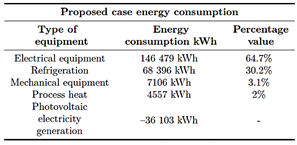
Table 12. Energy consumption in the proposed case, as modeled in RETScreen
|
|
A significant reduction in energy consumption is evident with the proposed implementation of the photovoltaic system, contributing to an annual decrease of 36,103 kWh, as summarizedin Table 12.
3.2.Associated Costs
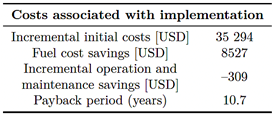
Regarding the costs associated with implementing the photovoltaic system, an increase in the initial investment is observed; however, a significant reduction in fuel expenses is achieved, representing a clear economic benefit. Although the return on investment occurs in the long term, the project offers advantages in the optimization of sustainable and environmentally friendly energy systems, as detailedin Table 13.
Table 13. Expenses considered for implementation of the photovoltaic system
The initial investment is relatively high, and the operation and maintenance costs present a negative value, indicating that they should be considered part of the expenses associated with the operation of the photovoltaic system.
3.3.Environmental Analysis
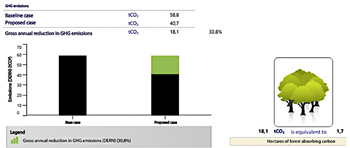
In the environmental impact analysis, parameters such as greenhouse gas (GHG) emission factors were considered, using a value of 0.213 tCO2/MWh as defined by the program for Ecuador. As shown in Figure 9, GHG emissions correspond to a gross annual reduction of approximately 18.1 tCO2, equivalent to the carbon sequestration capacity of about11.7 hectares of forest.
Figure 9. Gross annual reduction in GHG emissions |
In the baseline case, emissions totaled 58.8 tCO2, while in the proposed case they were reduced to 40.7 tCO2. In addition to the analysis of the photovoltaic system implementation, several immediately applicable measures are proposed. These alternatives are suggested because the system’s implementation cost may represent a limitation if a comprehensive preliminary assessment is not conducted. Accordingly, optimization options were identified and evaluated using the RETScreen platform.
3.4.Energy Management Measures in the Oilfield Camp
Kitchen Area
A baseline scenario and an improvement proposal were developed for the water heating system (8,000 L/day), based on historical records indicating that an electric generator served as the energy source for heat production. A 5 °C reduction in temperature was proposed for the hot water system, lowering the setpoint from 45.5 °C to 40.5 °C. From a thermodynamic perspective, this decrease implies that less energy is required to reach the target temperature. The decision to limit the reduction to 5 °C, rather than 10 °C, is based on maintaining a balance between energy efficiency and user thermal comfort. In practical terms, a 5 °C decrease ensures that the energy required for water heating remains directly proportional to the temperature difference, without compromising user comfort or system performance. Based on actual energy consumption data, the estimated annual savings are approximately 17,000 kWh, representing a 24.3% improvement in thermal performance. In the baseline case, consumption was 70,180 kWh/year, whereas in the proposed scenario, under the suggested operating conditions, it decreased to 53,147 kWh/year. This reduction results from both the temperature adjustment and the optimization of the usage cycle. As a complementary measure, a 25% reduction in the utilization cycle is proposed, which would decrease the overall thermal demand and, in turn, lower the frequency of preventive and corrective maintenance. For future research, a heat recovery analysis could be conducted on extraction systems through the implementation of extractor hoods designed to preheat water or supply secondary thermal processes within the camp. |
|
Camp Lighting Fixtures
To optimize the lighting systems across the different areas of the camp, the replacement of obsolete technologies, such as fluorescent lamps with electronic ballasts, with LED luminaires is proposed. In this analysis, total system losses of 25% were considered for both the baseline and the proposed cases. From a technical perspective, a 50% reduction in electrical demand was observed, decreasing from 41,151 kWh/year to 20,855 kWh/year, thereby improving the energy efficiency of the lighting systems. This improvement is attributed to the higher efficacy of the luminaires: while conventional lights with electronic ballasts operate at 70 lm/W, LED luminaires reach 85.5 lm/W, allowing the same illuminance levels (500 lux) to be maintained with a lower connected load. It is important to note that lighting systems must be adapted to an appropriate optical design, considering both directional and light dispersion characteristics. LED luminaires, which emit light directionally, minimize dispersion losses and help maintain the required illuminance level (500 lux) with fewer fixtures and a lower installed load. In contrast, fluorescent lamps with ballasts emit light omnidirectionally, requiring a greater number of fixtures. Consequently, LED technology reduces unit power demand from 150 W to 75 W per lamp, decreasing the total connected load from 4,688 W (T8 fluorescents) to 2,344 W (LEDs). For future research, it is recommended to conduct a more comprehensive analysis of lighting efficiency in critical areas, incorporating illuminance levels evaluated through specialized software such as DIALux. Furthermore, a comparative assessment between conventional LED luminaires and those equipped with presence sensors or automatic dimming is suggested to determine their additional energy-saving potential.
Air Conditioning Systems
The air conditioning system, composed of three units with a total capacity of 93,500 BTU/h, offers a significant opportunity to enhance efficiency by increasing the coefficient of performance (COP) from 3.0 to 3.5. From a thermodynamic standpoint, the COP expresses the ratio of useful cooling energy delivered to the energy consumed; thus, increasing the COP reduces overall energy consumption while maintaining the same cooling capacity. With a COP of 3.5, the energy demand of the air conditioning system decreases from 79,795 kWh/year to 68,396 kWh/year, representing a 14.28% reduction. This behavior aligns with the inverse proportional relationship between energy consumption and the COP. |
To achieve this COP value, the following strategies are proposed:
· Periodic preventive and corrective maintenance, including coil cleaning, verification of high and low pressures, and leak detection when applicable. · Improvements in the airtightness of airconditioned areas to reduce the thermal load and, consequently, the system’s operational demand. · Implementation of smart controls, such as programmable thermostats and occupancy sensors, to optimize operating cycles. · Integration of renewable energy technologies (e.g., aerothermal systems or solar thermal support for domestic hot water) to reduce compressor workload when applicable.
A 30 kWp photovoltaic system comprising 50 panels of 600 Wp each is proposed, achieving an estimated 30% reduction in displaceable electrical consumption. The system can be expanded through additional modules or complemented by replacing lighting fixtures with LED luminaires in critical areas. In addition, regular maintenance of the air conditioning system or replacement with inverter-type units using R410 refrigerant is recommended. In the future, improving the distribution of the photovoltaic load by prioritizing critical equipment and incorporating protective devices (e.g., remotely controlled load switches and, when feasible, energy storage systems) will enhance overall system resilience. For future research, it is recommended to evaluate the operating cycles of air conditioning and extraction systems by establishing real operating parameters, such as periods of peak thermal load and opportunities to reduce operation without compromising comfort, and to assess the compatibility of inverter-based equipment with low-GWP (Global Warming Potential) refrigerants.
4. Conclusions
The central focus of this study was to evaluate the technical, economic, and environmental impacts of the implemented measures. Accordingly, the primary objective was to achieve a reduction of between 15% and 30% in energy consumption in a remote oilfield camp. This analysis was conducted using the RETScreen platform, through which improvements were proposed for the air conditioning, lighting, and general service systems. Based on historical records, the initial electricity consumption was 271,148 kWh/year, with an associated cost of USD 27,454. In the proposed scenario, which incorporates a photovoltaic system to optimize |
|
energy use, consumption decreased to 185,878 kWh/year, representing a 31% reduction and annual cost savings of USD 8,527. The photovoltaic generation system, with an installed capacity of 30 kWp (not 30 kWh/year), reduced dependence on the National Interconnected System (SNI) and on polluting energy sources. Regarding energy efficiency distribution, the air conditioning systems achieved a 14.28% improvement, while the electrical systems, including pumps and lighting, registered the highest reduction, at 38.6%. The overall assessment indicates an average saving of 30.9% across the entire system. From an environmental perspective, CO2 emissions decreased from 58.8 tCO2 to 40.7 tCO2, equivalent to the carbon sequestration capacity of approximately 1.7 hectares of forest. The estimated return on investment of 10.7 years reinforces the proposal’s technical, economic, and environmental viability as a sustainable and replicable solution.
Contributor Roles
· Edwin Illescas: Conceptualization, formal analysis, writing – original draft, writing – review & editing, investigation, resources. · Edison Laz: Software, writing – original draft, writing – review & editing, validation, resources. · Manuel Rogelio Nevarez Toledo: Project administration. · Miguel Alberto Dávila-Sacoto: Supervision, project administration, methodology.
References
[1] E. A. Llanes Cedeño and O. D. Rubio Aguiar, Elaboración de una metodología de gestión energética para campos petroleros en el ecuador basada en la ISO 50001. Universidad Internacional SEK, 2022. [Online]. Available: https://upsalesiana.ec/ing35ar1r1 [2] B. Williams, D. Bishop, P. Gallardo, and J. G. Chase, “Demand side management in industrial, commercial, and residential sectors: A review of constraints and considerations,” Energies, vol. 16, no. 13, p. 5155, Jul. 2023. [Online]. Available: http://doi.org/10.3390/en16135155 [3] S. Mimi, Y. Ben Maissa, and A. Tamtaoui, “Optimization approaches for demand-side management in the smart grid: A systematic mapping study,” Smart Cities, vol. 6, no. 4, pp. 1630–1662, Jun. 2023. [Online]. Available: http://doi.org/10.3390/smartcities6040077 |
[4] S. S. Shuvo and Y. Yilmaz, “Demand-side and utility-side management techniques for increasing ev charging load,” IEEE Transactions on Smart Grid, vol. 14, no. 5, pp. 3889–3898, Sep. 2023. [Online]. Available: http://doi.org/10.1109/TSG.2023.3235903 [5] S. Charles Raja, A. C. Vishnu Dharssini, J. Jeslin Drusila Nesmalar, and T. Karthick, “Deployment of iot-based smart demand-side management system with an enhanced degree of user comfort at an educational institution,” Energies, vol. 16, no. 3, p. 1403, Jan. 2023. [Online]. Available: http://doi.org/10.3390/en16031403 [6] V. Cortez, R. Rabelo, A. Carvalho, A. Floris, and V. Pilloni, “On the impact of flexibility on demand-side management: Understanding the need for consumer-oriented demand response programs,” International Journal of Energy Research, vol. 2024, no. 1, Jan. 2024. [Online]. Available: http://doi.org/10.1155/2024/8831617 [7] D. Stanelyte, N. Radziukyniene, and V. Radziukynas, “Overview of demand-response services: A review,” Energies, vol. 15, no. 5, p. 1659, Feb. 2022. [Online]. Available: http://doi.org/10.3390/en15051659 [8] M. Alikhani, M. P. Moghaddam, F. Moazzen, and A. Azadi, “Optimal implementation of consumer demand response program with consideration of uncertain generation in a microgrid,” Electric Power Systems Research, vol. 225, p. 109859, Dec. 2023. [Online]. Available: http://doi.org/10.1016/j.epsr.2023.109859 [9] A. Piñeres Castillo, J. J. Cabello Eras, and M. Hinojosa Rivera, “Factores determinantes para la evaluación de la eficiencia energética en las organizaciones: una visión desde las condiciones de Colombia,” Universidad y Sociedad, vol. 14, no. 2, pp. 509–520, 2022. [Online]. Available: https://upsalesiana.ec/ing35ar1r9 [10] P. J. Ramos-Males and A. M. Bautista- Segovia, “La eficiencia energética: Una estrategia para la economía doméstica en Ecuador,” Dominio de las Ciencias, vol. 8, no. 2, pp. 1334–1346, 2022. [Online]. Available: https://upsalesiana.ec/ing35ar1r10 [11] R. Cancio-Bello, S. Montelier Hernández, A. Oviedo Regojo, and O. Bello Gonzalez, “Bases para la implementación de un sistema de gestión energética en la UEB Ron “Luis Arcos Bergnes” de Cienfuegos basado en la NC-ISO 50001:2019,” Universidad y Sociedad, vol. 13, no. 4, 2021. [Online]. Available: https://upsalesiana.ec/ing35ar1r11 |
|
[12] L. Freire, V. Resabala, J. Castillo, and B. Corrales, “Propuesta de un plan alternativo de optimización energética,” Espacios, vol. 40, no. 30, 2019. [Online]. Available: https://upsalesiana.ec/ing35ar1r12 [13] F. De La Cruz Cabrales Avila and R. A. M. Otero, “Sistemas fotovoltaicos: solución energética en las comunidades aisladas,” 2022. [Online]. Available: http://doi.org/10.5281/ZENODO.7461726 [14] G. S. Inca Yajamín, D. F. Cabrera Carrión, D. F. Villalta Gualán, R. C. Bautista Zurita, and H. D. Cabrera Carrion, “Evaluación de la actualidad de los sistemas fotovoltaicos en ecuador: avances, desafíos y perspectivas,” Ciencia Latina Revista Científica Multidisciplinar, vol. 7, no. 3, pp. 9493–9509, Jul. 2023. [Online]. Available: http://doi.org/10.37811/cl_rcm.v7i3.6835 [15] A. F. Guamán Mejía and L. V. Sánchez Parrales, “Importancia de la energía renovable para el alumbrado publico,” Revista Sinapsis, vol. 24, no. 1, 2024. [Online]. Available: https://upsalesiana.ec/ing35ar1r15 [16] J. R. López Escobedo, K. Nicolás Javier, and F. Garcia Reyes, “Optimización de energía eléctrica y luminosa en laboratorios y aulas de aprendizaje, aplicación sustentable con luminarias de tecnología led,” Tendencias en energías renovables y sustentabilidad, vol. 1, no. 1, pp. 93–100, Dec. 2022. [Online]. Available: http://doi.org/10.56845/terys.v1i1.108 |
[17] J. L. Rodríguez Muñoz, J. S. Pacheco Cedeño, C. M. Valencia Castillo, and J. d. J. Ramírez Minguela, “Energy and exergy analysis of an ejector-compression refrigeration cycle with double ihx,” REVISTA DE CIENCIAS TECNOLÓGICAS, vol. 6, no. 3, p. e261, Sep. 2023. [Online]. Available: http://doi.org/10.37636/recit.v6n3e261 [18] ONU, Las emisiones históricas del sector de la construcción, lo alejan de los objetivos de descarbonización. Naciones Unidas, 2022. [Online]. Available: https://upsalesiana.ec/ing35ar1r18 [19] IRENA, Integración de energías renovables de baja temperatura en los sistemas energéticos urbanos: lineamientos para los responsables de la formulación de políticas – Resumen. International Renewable Energy Agency, 2021. [Online]. Available: https://upsalesiana.ec/ing35ar1r19 [20] ISO, Guía de implementación e interpretación de requisitos del estándar ISO 50001:2018. Organización Internacional de Normalización, 2018. [Online]. Available: https://upsalesiana.ec/ing35ar1r20 [21] T. Jing and Y. Zhao, “Optimizing energy consumption in smart buildings: A model for efficient energy management and renewable integration,” Energy and Buildings, vol. 323, p. 114754, Nov. 2024. [Online]. Available: http://doi.org/10.1016/j.enbuild.2024.114754 |