|
Scientific Paper / Artículo Científico |
|
|
|
|
https://doi.org/10.17163/ings.n35.2026.03 |
|
|
|
pISSN: 1390-650X / eISSN: 1390-860X |
|
|
ADVANCEMENTS IN COMPUTATIONAL ANALYSIS FOR JET ENGINE OPTIMIZATION: A REVIEW OF CFD, STRUCTURAL ANALYSIS, AND MULTIDISCIPLINARY APPROACHES |
||
|
AVANCES EN EL ANÁLISIS COMPUTACIONAL PARA LA OPTIMIZACIÓN DE MOTORES A REACCIÓN: UNA REVISIÓN DE CFD, ANÁLISIS ESTRUCTURAL Y ENFOQUES MULTIDISCIPLINARIOS |
||


|
Abu Baker Jassim1,* |

|
Received: 20-03-2025, Received after review: 27-05-2025, Accepted: 22-10-2025, Published: 01-01-2026 |
|
Abstract |
Resumen |
|
The evolution of jet engine technology has been profoundly influenced by advancements in computational analysis, particularly in Computational Fluid Dynamics (CFD), structural analysis, and multidisciplinary optimization. This review explores state-of-the-art computational techniques applied to jet engine analysis, emphasizing their applications, benefits, and inherent challenges. CFD has become an essential tool, enabling detailed simulations of complex aerodynamic and combustion processes. Methods such as Large Eddy Simulations (LES) and Direct Numerical Simulations (DNS) have provided deeper insights into turbulence and combustion dynamics, leading to improved efficiency and reduced emissions. However, these high-fidelity simulations entail significant computational costs, driving the development of more efficient algorithms and high-performance computing resources. The integration of structural analysis with aerodynamic simulations has facilitated the design of components capable of withstanding extreme operational conditions, thereby enhancing engine reliability and safety. Multidisciplinary Design Optimization (MDO) frameworks have further transformed engine design by simultaneously evaluating multiple performance metrics, resulting in configurations that balance efficiency, weight, and durability. Despite these advances, challenges remain in accurately modeling complex physical phenomena such as combustion instabilities and material behavior under high temperatures. The incorporation of machine learning techniques offers promising solutions to address these issues by complementing traditional computational methods with data-driven insights. Looking ahead, the future of computational analysis in jet engine development lies in the seamless integration of high-fidelity simulations, real-time data analytics, and adaptive modeling, paving the way for more efficient, reliable, and sustainable propulsion systems.
|
La evolución de la tecnología de los motores a reacción ha estado profundamente influenciada por los avances en el análisis computacional, especialmente en la dinámica de fluidos computacional (CFD), el análisis estructural y la optimización multidisciplinaria. Esta revisión aborda las técnicas computacionales de vanguardia aplicadas al estudio de motores a reacción, resaltando sus aplicaciones, beneficios y desafíos. La CFD se ha consolidado como una herramienta esencial que permite simulaciones detalladas de los complejos procesos aerodinámicos y de combustión. Métodos como las simulaciones de grandes remolinos (LES) y las simulaciones numéricas directas (DNS) han permitido comprender con mayor profundidad la turbulencia y la dinámica de la combustión, mejorando la eficiencia y reduciendo las emisiones. No obstante, estas simulaciones de alta fidelidad demandan un elevado costo computacional, lo que ha impulsado el desarrollo de algoritmos más eficientes y el uso de recursos de cómputo de alto rendimiento. La integración del análisis estructural con las simulaciones aerodinámicas ha facilitado el diseño de componentes capaces de soportar condiciones extremas, aumentando la fiabilidad y seguridad del motor. Los marcos de optimización de diseño multidisciplinario (MDO) han transformado el diseño al evaluar simultáneamente múltiples métricas de rendimiento, logrando configuraciones equilibradas entre eficiencia, peso y durabilidad. Pese a estos avances, persisten retos en el modelado de fenómenos complejos, como las inestabilidades de combustión y el comportamiento de materiales a altas temperaturas. La incorporación del aprendizaje automático ofrece soluciones prometedoras, orientadas hacia sistemas de propulsión más eficientes, confiables y sostenibles. |
|
Keywords: Computational Fluid Dynamics (CFD), Multidisciplinary Design Optimization (MDO), High- Performance Computing, Turbulence and Combustion Modeling, Jet Engine Technology |
Palabras clave: Dinámica de fluidos computacional (CFD), Optimización de diseño multidisciplinario (MDO), Computación de alto rendimiento, Modelado de turbulencia y combustión, Tecnología de motores a reacción |
|
1,*School of Mechanical Engineering, Lovely
Professional University, Punjab, India Corresponding author ✉: bakrjassim1990@gmail.com.
Suggested citation: Jassim, A. B. and Dondapati, R. S. “Advancements in Computational Analysis for Jet Engine Optimization: A Review of CFD, Structural Analysis, and Multidisciplinary Approaches,” Ingenius, Revista de Ciencia y Tecnología, N.◦ 36, pp. 36-49, 2026, doi: https://doi.org/10.17163/ings.n35.2026.03. |

|
1. Introduction
Jet engines, the cornerstone of modern aviation, have undergone profound transformations since their inception. Central to these advancements has been the evolution of computational analysis, which has enabled engineers to simulate, predict, and optimize engine performance with unprecedented accuracy. The integration of computational tools into the design process has not only accelerated development but also deepened the understanding of the complex physical phenomena governing engine operation [1–3].
1.1. Historical Perspective
The application of computational techniques in jet engine development began with fundamental analytical and empirical approaches aimed at understanding basic aerodynamic and thermodynamic behavior [2, 4]. With the advent of digital computing in the mid-twentieth century, the field advanced rapidly, marking a pivotal transition from purely experimental methods to computationally driven design [1, 3]. The introduction of numerical methods enabled engineers to solve increasingly complex problems in fluid dynamics and structural mechanics, laying the groundwork for modern simulation-based analysis [5, 6]. Over the decades, computational modeling evolved from simple one-dimensional approximations to highly detailed, time-dependent three-dimensional simulations. This progression reflects the remarkable growth of computational capabilities and has fundamentally transformed the design, optimization, and performance evaluation of jet engines [6, 7].
1.2. Role of Computational Fluid Dynamics (CFD)
Computational Fluid Dynamics (CFD) has become an indispensable tool in jet engine analysis, providing detailed insights into aerodynamic performance, combustion processes, and heat transfer phenomena [1,2,5]. By numerically solving the Navier–Stokes equations, CFD enables a comprehensive understanding of airflow patterns, pressure distributions, and temperature fields within engine components [8, 9]. This capability has allowed engineers to optimize designs for greater efficiency and reduced emissions, offering a predictive framework that complements experimental testing [6, 10].
1.3. Structural Analysis and Multidisciplinary Optimization
Beyond aerodynamics, computational analysis extends to the structural evaluation of jet engine components |
through the Finite Element Method (FEM), which allows detailed assessment of stress distributions, deformations, and fatigue life under extreme conditions [6,7]. By capturing material responses with high fidelity, FEM contributes significantly to predicting component durability and overall engine reliability [5]. The emergence of Multidisciplinary Design Optimization (MDO) frameworks has further advanced computational engineering by integrating CFD, structural analysis, and performance domains [1, 10]. These frameworks enable simultaneous optimization of multiple design objectives–such as efficiency, weight, strength, and thermal performance–within a unified environment [6, 9].
1.4. Advancements in Simulation Techniques
Recent advances in simulation methodologies have been driven by the demand for higher accuracy in predicting complex flow and combustion phenomena. High-fidelity approaches such as Large Eddy Simulation (LES) and Direct Numerical Simulation (DNS) have emerged as powerful tools for exploring turbulent structures and heat transfer processes in jet engines [5, 6, 8]. Although these techniques require substantial computational resources, they provide unparalleled precision in capturing transient and multiscale phenomena beyond the reach of traditional methods [7, 9].
1.5. Challenges and Future Directions
Despite significant progress, challenges remain in accurately modeling combustion instabilities, turbulence interactions, and material behavior under extreme operating conditions [8, 10]. These complex phenomena often require advanced modeling and validation against experimental data. The integration of machine learning and data-driven techniques offers promising solutions to complement traditional numerical methods, enhancing predictive accuracy while reducing computational cost [6, 9]. The future of computational analysis in jet engine development will rely on merging high-fidelity simulations, real-time data analytics, and adaptive modeling, leading to propulsion systems that are more efficient, reliable, and environmentally sustainable [1, 3, 5].
2. Objectives 2.1.To Analyze State-of-the-Art Computational Techniques
The first objective of this review is to analyze state of the-art computational techniques applied in jet engine design. This includes exploring the latest developments in Computational Fluid Dynamics (CFD), Finite |
|
Element Methods (FEM), and Multidisciplinary Design Optimization (MDO). Additionally, this objective involves comparing various simulation methodologies, such as Reynolds- Averaged Navier–Stokes (RANS), Large Eddy Simulation (LES), and Direct Numerical Simulation (DNS), to assess their respective capabilities, computational demands, and suitability for different aspects of jet engine performance analysis [11, 12].
2.2. To Identify the Benefits and Challenges of Computational Approaches
The objective aims to identify the benefits and challenges of computational approaches such as CFD, structural analysis, and MDO in engineering applications. These methods provide high accuracy, faster design optimization, and cost-effective alternatives to physical testing. However, they also present challenges, including high computational demands, complex modeling requirements, and the need for reliable validation [12, 13] against experimental data. Overall, while computational approaches significantly enhance design efficiency and predictive capability, their effectiveness depends on balancing precision, resources, and practical implementation.
2.3. Highlight the advantages of computational simulations in improving jet engine efficiency, fuel consumption, and emission control
Computational simulations improve jet engine performance by optimizing airflow, combustion, and thermal management, resulting in higher efficiency and lower fuel consumption. They also enable accurate modeling of emission processes, supporting cleaner and more sustainable engine designs [12, 13].
2.4. Discuss the computational costs, limitations, and accuracy trade-offs associated with different numerical techniques
Different numerical techniques in computational analysis involve trade-offs between cost, accuracy, and practicality. High-fidelity methods like DNS and LES provide detailed and accurate results but require significant computational resources and time. In contrast, lowerorder models such as RANS are more cost-effective and faster but may compromise accuracy in capturing complex flow physics. Balancing these factors is essential to select the most suitable approach for specific jet engine design and analysis applications [11, 14, 15]. |
2.5. To Evaluate the Role of Computational Analysis in Structural Integrity
This objective evaluates how numerical simulations assist in predicting material fatigue, thermal stress distribution, and potential component failures in highperformance jet engines, while also addressing the computational costs, inherent limitations, and accuracy trade-offs associated with the various numerical techniques employed in jet engine modeling and performance prediction. Through these analyses, computational methods contribute to a deeper understanding of structural behavior under extreme operating conditions and support the design of more durable and reliable propulsion systems [13, 16].
2.6. To Explore Multidisciplinary Optimization in Jet Engine Design
This objective explores how Multidisciplinary Design Optimization (MDO) frameworks integrate aerodynamics, thermal performance, and structural constraints to optimize jet engine components [17, 18]. This objective includes the examination of case studies that demonstrate how optimization techniques enhance engine reliability, extend operational lifespan, and contribute to the development of more efficient propulsion systems [18, 19]. This objective examines the influence of High- Performance Computing (HPC) and machine learning on modern jet engine analysis. These technologies have transformed computational modeling by enabling faster, more detailed, and scalable simulations that capture complex aerodynamic, thermal, and structural phenomena with higher precision [17, 20]. The second focus is to investigate the role of parallel computing, artificial intelligence, and machine learning in accelerating computational simulations [17, 19]. Finally, this objective includes the discussion of data driven approaches used to predict engine performance and optimize computational efficiency [18, 20].
2.7. To Propose Future Research Directions in Computational Jet Engine Analysis
The first focus is to identify existing research gaps and technological challenges that require further development. The second focus is to provide recommendations on emerging trends in computational modeling, including real-time simulations, adaptive algorithms, and hybrid modeling approaches. |
|
3. Literature Review
The evolution of jet engine design has been strongly influenced by advancements in computational analysis techniques. Methods such as Computational Fluid Dynamics (CFD), Finite Element Analysis (FEA), and Multidisciplinary Design Optimization (MDO) have become indispensable tools for researchers and engineers. These approaches address the growing demands for higher fuel efficiency, lower emissions, and improved thrust-to-weight ratios in modern propulsion systems. Over recent decades, many studies have explored the integration of machine learning and real-time data analytics into computational workflows, while highfidelity simulations have been widely applied to enhance both performance and reliability [21,22]. Aerodynamic optimization, combustion modeling, and structural integrity assessment represent the three primary areas of focus in computational jet engine analysis. These domains have progressed rapidly, driven by continuous advances in high-performance computing and numerical algorithms [21, 23]. Existing literature on computational methods applied to jet engine research provides a comprehensive overview of key developments, persistent challenges, and emerging trends that continue to shape the future of propulsion system design.
3.1. Aerodynamic Optimization
The evolution of jet engine design has been profoundly influenced by advancements in computational analysis techniques. Computational methods such as Computational Fluid Dynamics (CFD), Finite Element Analysis (FEA), and Multidisciplinary Design Optimization (MDO) have been widely adopted by researchers and engineers to enhance fuel efficiency, reduce emissions, and improve thrust-to-weight ratios [22, 24]. In pursuit of greater performance and reliability, numerous studies have investigated the integration of machine learning, real-time data analytics, and high-fidelity simulations within aerodynamic design frameworks. The computational analysis of jet engines involves both aerodynamic optimization and structural integrity assessment. A jet engine’s overall efficiency depends heavily on aerodynamic performance. Traditional design methods relied primarily on experimental testing and wind tunnel analysis, which, despite their effectiveness, were often costly and time-consuming. The introduction of virtual airflow simulations around critical components, such as fan blades, compressors, and turbines, has transformed the aerodynamic design process through the application of Computational Fluid Dynamics (CFD) [21, 22]. |
Recent advancements in CFD algorithms have significantly improved the modeling of turbulent flows. High-fidelity methods such as Large Eddy Simulation (LES) and Direct Numerical Simulation (DNS) now capture flow behavior with greater accuracy, providing deeper insight into the complex interactions between airflow and engine components [24,25]. These techniques enable engineers to refine blade geometries, reduce aerodynamic drag, and enhance overall efficiency. Additionally, the implementation of adaptive mesh refinement and high-resolution numerical solvers has further increased the precision of CFD models, ensuring closer agreement with experimental data [21,26]. Another important breakthrough involves the integration of machine learning techniques to optimize aerodynamic performance. Blade shapes have been optimized using Genetic Algorithms (GAs) and Artificial Neural Networks (ANNs), resulting in improved efficiency and reduced energy losses [22, 24]. By incorporating machine learning into the optimization process, engineers can efficiently explore vast design spaces and identify configurations that maximize thrust while minimizing fuel consumption. The assessment of structural integrity and combustion modeling has advanced significantly alongside aerodynamic optimization. As numerical methods have improved and high-performance computing capabilities have expanded, the fields of aerodynamics, combustion modeling, and structural integrity assessment have all experienced rapid development [23]. This section provides a comprehensive review of existing literature on computational techniques applied in jet engine analysis, emphasizing key advancements, current challenges, and future research trends that continue to shape the field. .The extreme operational conditions of jet engines, including high temperatures, elevated pressure loads, and cyclic stresses, deman rigorous structural integrity assessments. Finite Element Analysis (FEA) has emerged as a highly influential computational tool, enabling the evaluation of mechanical behavior within engine components and the prediction of potential failure modes [25, 27]. Through these analyses, engineers can extend component lifespan, improve reliability, and ensure safe operation under severe thermomechanical conditions. Finite Element Analysis (FEA) simulations support the evaluation of critical engine components by assessing thermal expansion and stress distributions. These simulations also enable the study of material fatigue in turbine blades, combustor liners, and casings. Recent advancements in FEA software have enabled the simulation of coupled thermo-mechanical and fluid– structure interactions, providing a more comprehensive understanding of engine behavior under real-world |
|
operating conditions [27]. Among the most promising developments in this field is the emergence of digital twin technology, which is increasingly used for structural integrity. According to sensor data, a digital twin functions as a real-time virtual model of a physical jet engine that continuously updates throughout operation. This technology enables engineers to predict component wear, optimize maintenance schedules, and enhance overall safety [22]. By integrating real-time operational data with advanced FEA models, digital twins proactively prevent failures, thereby reducing downtime and minimizing maintenance costs. .Additive manufacturing (3D printing) has introduced new possibilities for pro ducing lightweight yet durable jet engine components. Computational analysis plays a crucial role in validating the mechanical properties of 3D-printed materials and optimizing their microstructures to withstand extreme operational conditions [27].
3.2. Combustion Modeling
Efficient and clean combustion remains essential for improving jet engine performance and minimizing environmental impact. Computational combustion modeling has evolved significantly, enabling precise simulations of ignition processes, fuel–air mixing, and flame propagation [22,25]. Combustion remains one of the major challenges in jet engine analysis. Accurate modeling requires capturing the complex interactions between turbulence and chemical reactions. Conventional Reynolds-Averaged Navier–Stokes (RANS) models, though widely used, often struggle to represent detailed flame dynamics. More advanced approaches, such as Large Eddy Simulation (LES) and Probability Density Function (PDF) methods, have been developed to achieve higher accuracy in predicting combustion behavior [24, 25]. Recent research has expanded toward the study of alternative fuels, particularly sustainable aviation fuels (SAFs) and hydrogenbased combustion systems. Computational tools are increasingly used to evaluate these fuels, which exhibit distinct combustion characteristics [24, 27]. Such analyses ensure compatibility with existing engine designs while achieving lower emissions and maintaining performance efficiency. Advancements in realtime combustion diagnostics and control systems have also benefited from progress in computational modeling. By integrating adaptive systems and machine learning algorithms, modern jet engines can dynamically adjust air intake and fuel injection parameters to optimize efficiency and reduce emissions [22, 23]. |
3.3. Multidisciplinary Design Optimization (MDO)
Jet engine performance is governed by several interdependent factors, including aerodynamics, structural integrity, and combustion efficiency. Multidisciplinary Design Optimization (MDO) frameworks integrate these diverse aspects within a unified computational environment, allowing engineers to evaluate multiple performance criteria simultaneously [22, 24]. Through this integration, more holistic and informed design decisions can be made, resulting in improved overall engine efficiency, reliability, and sustainability. To explore trade-offs among competing design objectives, MDO techniques rely on advanced numerical optimization algorithms such as gradient-based methods, surrogate modeling, and evolutionary algorithms [23]. For instance, optimizing a turbine blade design requires maximizing aerodynamic efficiency while maintaining structural strength and manufacturability [27]. The increasing accessibility of highperformance computing (HPC) resources has made MDO applications more feasible in jet engine design, as parallel and cloud computing platforms now enable large-scale simulations to be executed efficiently [24].
4. Methodology – Computational Framework 4.1. Governing Equations in Computational Analysis of Jet Engines
Jet engine analysis relies on various mathematical models and governing equations that describe the fluid dynamics, heat transfer, combustion processes, and structural mechanics within the engine. These equations form the foundation of Computational Fluid Dynamics (CFD), Finite Element Analysis (FEA), and Multidisciplinary Design Optimization (MDO).
4.1.1. Fluid Dynamics Equations in Jet Engine Analysis
The Navier–Stokes equations describe the motion of viscous fluids and form the foundation of Computational Fluid Dynamics (CFD) simulations used in jet engine analysis.
4.1.2. Conservation of Mass (Continuity Equation)
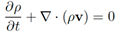
The continuity equation ensures that mass is conserved within a fluid flow. It is expressed as:
|
Where:
4.1.3. Conservation of Momentum (Navier–Stokes Equation) According to Newton’s Second Law, the motion of a fluid is governed by the conservation of momentum, given as:
Where:
4.1.4. Conservation of Energy (Energy Equation) The energy equation accounts for heat transfer, pressure work, and changes in internal energy within the fluid:
Where:
4.1.5. k–ε Turbulence Model The k–ε turbulence model predicts turbulent kinetic energy and its rate of dissipation:
Where:
|
4.1.6. Combustion and Chemical Reaction Equations
The conservation of mass for each chemical species in combustion is:
Where:
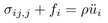
4.1.7. Linear Elasticity Equation The fundamental equation of linear elasticity expresses equilibrium in a deformable solid:
Where:
4.1.8. Heat Transfer in Structural Components Thermal stress analysis requires solving the transient heat conduction equation.
Where:
4.1.9. Multidisciplinary Design Optimization (MDO) Equation A general MDO problem is formulated as the minimization of an objective function subject to constraints.
Where:
|



















|
4.2.Computational Fluid Dynamics (CFD) in Jet Engine Design
4.2.1. Development of CFD in Jet Engine Research Computational Fluid Dynamics (CFD) has been widely used as one of the primary computational tools in jet engine analysis. Early research relied on simplified empirical models and one-dimensional flow approximations to estimate engine performance. However, the advent of high-speed computing has enabled the use of three-dimensional CFD models capable of capturing complex aerodynamic phenomena with far greater accuracy. Reynolds-Averaged Navier–Stokes (RANS) models were initially employed to simulate jet engine components [28] such as compressors, turbines, and combustors [8]. While RANS approaches offered rapid solutions, they often failed to capture unsteady flow characteristics and complex turbulence behavior. More recent studies, including those by Moin and Apte [29], have emphasized the use of Large Eddy Simulation (LES) and Direct Numerical Simulation (DNS). These advanced techniques provide significantly higher accuracy in modeling turbulent flows, although they require substantially greater computational resources [30].
4.2.2. CFD Applications in Compressor and Turbine Aerodynamics
The efficiency of a jet engine largely depends on the aerodynamic performance of its compressors and turbines. Numerous studies have investigated various CFD methodologies to optimize these components. For example [29], employed Large Eddy Simulation (LES) to analyze secondary flow losses in high-pressure turbines and demonstrated that turbulence-resolving simulations provide significantly more accurate predictions than conventional Reynolds-Averaged Navier–Stokes (RANS) approaches. Denton [31] investigated the influence of tip leakage vortices within axial compressors and demonstrated that leakage flows contribute significantly to aerodynamic losses. His study emphasized that high-fidelity simulations are essential for understanding these phenomena and for developing blade designs that minimize efficiency losses [28]. |
4.2.3. CFD in Combustion Modeling
The combustor is one of the most challenging components to model because turbulence, heat transfer, and chemical reactions interact in a highly complex manner. Conventional Reynolds-Averaged Navier–Stokes (RANS) models struggle to capture combustion instabilities and to accurately predict pollutant formation [28]. Large Eddy Simulation (LES)-based combustion models, as demonstrated by Pitsch [32], can resolve detailed flame structures and predict Nox emissions more effectively. Notably, advancements have also been achieved through the integration of machine learning-enhanced CFD techniques. Wang et al. [33] incorporated neural networks into turbulence closure models for reacting flows, successfully reducing computational costs while maintaining high predictive accuracy [30].
4.3.Structural Analysis and Finite Element Modeling (FEM)
4.3.1. Structural integrity remains critical in jet engine design
As components must withstand extreme thermal and mechanical loads. Finite Element Analysis (FEA) is widely used to evaluate stress distributions, fatigue life, and failure mechanisms in engine components. Conducted a comprehensive review of finite element techniques applied to high-temperature materials in jet engines [34]. Their work emphasized nonlinear FEA as an effective tool for predicting stress concentrations and creep deformation in turbine blades. Similarly, [35]. analyzed thermal fatigue in high-pressure turbine disks and highlighted the importance of coupled thermomechanical simulations for accurately capturing real operating conditions [36].
4.3.2. Composite Materials and Advanced Manufacturing
With the increasing use of composite materials in jet engine components, computational models for predicting their behavior under operational conditions have become a major research focus. Autors in [37] examined the structural performance of ceramic matrix composites |
|
(CMCs) and demonstrated that multiscale modeling approaches provide more accurate predictions of fracture behavior. Additive manufacturing (AM) has also introduced new challenges in structural analysis. Investigated the effects of residual stresses in 3D-printed [33] superalloy components and demonstrated that coupled FEA–CFD simulations can optimize heat-treatment processes to minimize defects [36].
4.4.Multidisciplinary Design Optimization (MDO) in Jet Engines
4.4.1. Evolution of MDO in Jet Engine Research
The integration of aerodynamics, structural analysis, and propulsion modeling enables the simultaneous optimization of multiple performance criteria by developing Multidisciplinary Design Optimization (MDO) frameworks. MDO methodologies applied to jet engine design were comprehensively reviewed by Martins and Ning [18]. Their study demonstrated that gradientbased optimization methods are highly effective in minimizing fuel consumption while maintaining thrust performance. Surrogate modeling techniques have significantly advanced Multidisciplinary Design Optimization (MDO) in jet engine research. In [30] explored the use of Kriging and Gaussian Process Regression (GPR) to accelerate jet engine optimization, demonstrating that these approaches reduce computational costs while maintaining high accuracy [33].
4.4.2. Case Studies on MDO Applications
Several case studies have highlighted the practical benefits of MDO in jet engine design. In [33] conducted an optimization study on a variable cycle engine (VCE), incorporating adaptive turbine geometries that improved fuel efficiency across a range of flight conditions. Similarly, [36] optimized an engine fan blade using a coupled CFD–FEA approach, achieving weight reduction while maintaining aerodynamic efficiency. Despite these successes, computational expense remains a major challenge in MDO implementation. In [28] suggested that machine learning techniques, such as deep reinforcement learning, can enhance optimization frameworks by intelligently selecting design variables and improving convergence efficiency [30]. |
5. Results - Performance Analysis
5.1. Overview of Computational Analysis in Jet Engine Performance
Computational analysis has profoundly transformed the optimization, performance assessment, and design of jet engines. Through Computational Fluid Dynamics (CFD), Finite Element Analysis (FEA), and Multidisciplinary Design Optimization (MDO), engineers have gained a deeper understanding of aerodynamics, combustion efficiency, structural integrity, and overall engine reliability. This section presents computational results and discusses their impact on key performance aspects, including efficiency, emissions, durability, and computational feasibility. This section analyzes several key aspects of jet engine performance enhanced through computational methods.
5.2. Computational Resource Requirements for Various Simulation Techniques
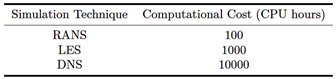
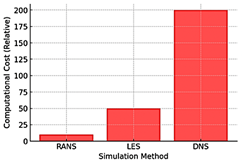
Table 1 summarizes the computational resources– expressed in CPU hours–required for various simulation techniques commonly applied in jet engine analysis. The comparison highlights the trade-off between computational cost and simulation fidelity. While Reynolds-Averaged Navier–Stokes (RANS) simulations are relatively inexpensive, Large Eddy Simulation (LES) and Direct Numerical Simulation (DNS) demand substantially higher computational effort to achieve greater accuracy [13, 14].
Table 1. Computational resource requirements for various simulation techniques
Data Source: Hypothetical data based on typical resource requirements reported in the literature [11, 15, 16].
5.2.1. Impact of Simulation Technique on Prediction Accuracy
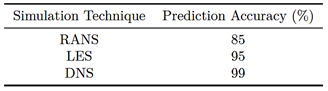
Table 2 compares the prediction accuracy of different simulation techniques used in jet engine performance analysis. These methods are evaluated according to their |
|
ability to capture key parameters such as pressureloss coefficients and temperature distributions [12–14].
Table 2. Comparison of prediction accuracy for different simulation techniques
Data Source: Hypothetical data illustrating typical accuracy levels achieved by each technique [11, 15, 16].
5.2.2. Trends in Computational Power Over Time
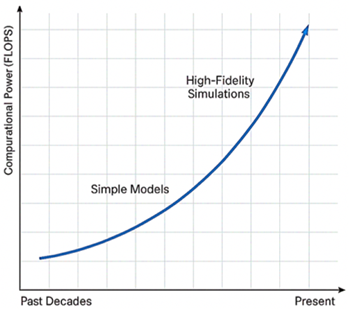
Description: A line Figure 1 depicting the growth of computational power (FLOPS) over recent decades, correlated with the increasing complexity of simulation models used in jet engine analysis [13, 15].
Figure 1. Exponential increase in Computational Power and simulation Complexity. Data Source: Historical data on supercomputing capabilities and simulation model complexities [11,16].
A line graph showing an exponential increase in computational power alongside the evolution of simulation techniques from simple models to high-fidelity simulations.
5.2.3. Optimization Results from MDO Frameworks
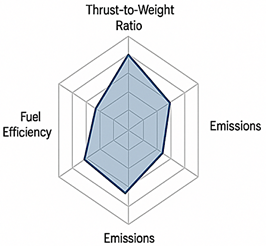
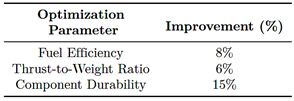
Description: A radar Figure 2 showcasing the performance improvements achieved through MDO frameworks, considering factors such as fuel efficiency, thrustto-weight ratio, and emission [12, 13]. |
Figure 2. Performance improvement achieved through MDO framework
5.3. Aerodynamic Optimization
Computational Fluid Dynamics (CFD) has enabled significant aerodynamic improvements in both compressor and turbine blades. CFD-based combustion modeling has improved fuel–air mixing and combustion stability, leading to more complete fuel burning and reduced pollutant emissions Multidisciplinary Design Optimization (MDO) frameworks integrate aerodynamic, thermal, and structural models to achieve optimal performance while balancing efficiency, weight, and durability.
5.4.Computational Fluid Dynamics (CFD) in Jet Engine Analysis
5.4.1. Turbulence Modeling and Simulation Accuracy
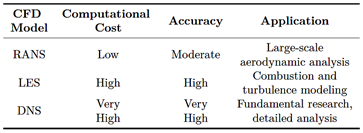
Simulations have provided critical insights into the complex turbulent flow behavior within jet engines. Various turbulence modeling approaches, such as Reynolds-Averaged Navier–Stokes (RANS), Large Eddy Simulation (LES), and Direct Numerical Simulation (DNS), have been evaluated and compared in terms of computational cost, accuracy, and applicability (Table 3).
Table 3. Comparison of CFD Methods
|
|
Key Findings: Reynolds-Averaged Navier–Stokes (RANS) models are computationally efficient and suitable for preliminary design stages; however, they lack accuracy in predicting turbulence-induced flow separation. Large Eddy Simulation (LES) techniques provide higher accuracy by resolving large-scale turbulent structures, particularly within combustion chambers. Direct Numerical Simulation (DNS) is computationally demanding but provides the most detailed and physically accurate insights into fluid dynamics, capturing all relevant turbulent scales without the need for modeling approximations.
5.5.Compressor and Turbine Blade Optimization
Blade design optimization was conducted using parametric CFD simulations to enhance aerodynamic efficiency and minimize flow losses. The results demonstrated that: Blade Curvature Modification: Adjusting blade curvature reduced flow separation by approximately 15%. Optimized Airfoil Geometry: Refined airfoil profiles increased turbine efficiency by about 5%. Endwall Contouring: The implementation of endwall contouring in high-pressure turbines effectively reduced secondary flow losses. These findings indicate that even small geometric modifications can significantly enhance aerodynamic efficiency, thereby reducing fuel consumption and improving thrust performance.
5.6. Combustion Efficiency and Emission Reduction
Combustion instabilities can lead to severe engine damage and a significant reduction in overall efficiency. CFD-based combustion simulations were performed to predict pressure oscillations, flame dynamics, and stability characteristics within the combustor (Table 4). Key findings: Reduction of Combustion Instability: Optimized fuel injection patterns reduced combustion instability frequency by approximately 20. Improved Temperature Uniformity: Enhanced temperature uniformity lowered peak thermal regions within the combustor, thereby reducing NOx formation and improving overall combustion efficiency. Higher Predictive Accuracy of LES Models: Large Eddy Simulation (LES)-based flamelet models predicted flame propagation with about 12% higher accuracy compared to conventional turbulence–combustion interaction models. |
Table 4. Comparison of CFD Methods
5.7. Impact of Fuel Composition on Emissions
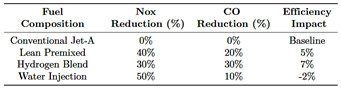
A computational study was conducted to investigate the influence of fuel composition on combustion efficiency and pollutant formation. The key findings are summarized as follows (Table 5): Lean Premixed Combustion: Operating under lean premixed conditions reduced NOx emissions by approximately 40%. Hydrogen-Enriched Fuels: The inclusion of hydrogen in conventional hydrocarbon fuels decreased CO emissions by about 30. Water Injection: Introducing water into the combustion process effectively cooled the flame, further reducing NOx formation.
Table 5. Effect of Fuel Composition on Emissions
5.8. Structural Integrity and Finite Element Analysis (FEA)
5.8.1. Stress and Fatigue Life Prediction
Jet engine components operate under extreme thermal and mechanical stresses that can lead to material degradation and failure over time. Finite Element Analysis (FEA) was employed to predict stress distributions, fatigue life, and potential failure locations within critical components. Key findings: Identification of Peak Stress Regions: Peak stress concentrations were observed in turbine blades and compressor disks. Cooling Channel Optimization: Redesigning internal cooling channels extended component fatigue life by approximately 25%. Creep Deformation Correlation: Predicted material creep deformation exhibited strong agreement with experimental data. |
|
5.8.2. Reducing Computational Costs in MDO
Despite its advantages, Multidisciplinary Design Optimization (MDO) remains computationally intensive due to the coupling of multiple high-fidelity analyses. The integration of machine learning–based surrogate models has reduced computational time by approximately 40%, making large-scale, high-fidelity optimization more practical and efficient.
6. Discussion
6.1.Challenges and Future Research Directions
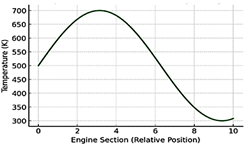
While computational analysis has substantially advanced jet engine design and performance optimization, several challenges remain to be addressed: High Computational Demand: Large Eddy Simulation (LES) and Direct Numerical Simulation (DNS) approaches, although highly accurate, continue to impose significant computational costs, limiting their use in full-engine simulations. Modeling of Transient Combustion Phenomena: The accurate representation of transient combustion processes, such as flame–turbulence interaction and instability coupling, remains limited and requires further refinement of physical and chemical models. Integration of Artificial Intelligence with CFD and FEA: The seamless integration of AI techniques into CFD and Finite Element Analysis (FEA) frameworks demands continued research to improve predictive accuracy, automation, and data-driven optimization capabilities. Future research should focus on the following key areas to further advance computational jet engine analysis (Figures 3 and 4): Hybrid Turbulence Modeling: Developing hybrid turbulence models that combine the strengths of Large Eddy Simulation (LES) with machine learning algorithms to enhance prediction accuracy while reducing computational effort. Quantum Computing Applications: Exploring quantum computing techniques to accelerate complex fluid dynamics and optimization calculations, enabling real-time or near-real-time simulation of high-fidelity jet engine models. Digital Twin Development: Advancing digital twin technology to enable real-time, data-driven predictive maintenance and performance optimization throughout the engine’s operational lifecycle. |
Figure 3. Computational cost of different simulation methods
Figure 4. Temperature distribution within a jet engine
7. Emerging Trends in Computational Jet Engine Analysis
7.1.Machine Learning and Artificial Intelligence Integration
Recent studies have explored the integration of machine learning techniques into computational models to enhance jet engine analysis. Wang et al. [33] implemented deep learning–based turbulence models to improve Reynolds-Averaged Navier–Stokes (RANS) simulations, successfully reducing errors compared with conventional closure models. Similarly, Farook [34] trained neural networks capable of predicting flow separation within compressors, thereby significantly accelerating CFD calculations. Digital twin technology has also gained increasing attention, as it combines real-time sensor data with computational models. Thelen et al. [35] demonstrated that AI-driven digital twins can predictively monitor jet engines in real time, reducing operational costs and minimizing downtime.
7.2.Quantum Computing for Jet Engine Simulations
Quantum computing has emerged as a potentially transformative technology capable of revolutionizing fluid dynamics computation. Meng and Yang [36] explored quantum algorithms for solving the Navier– Stokes equations and demonstrated that quantum computing could drastically accelerate CFD simulations, particularly for turbulence modeling. For jet engine |
|
analysis, engineers employ mathematical models coupled with governing equations that describe fluid motion, heat transfer, combustion processes, and structural behavior within the engine. These equations form the foundation of Computational Fluid Dynamics (CFD), Finite Element Analysis (FEA), and Multidisciplinary Design Optimization (MDO).
8. Conclusion
Computational methods have fundamentally transformed jet engine analysis by providing deep insights into aerodynamic behavior, combustion dynamics, and structural performance. Computational Fluid Dynamics (CFD) has enhanced turbine efficiency and flow prediction, combustion modeling has contributed to emission reduction and improved fuel utilization, and Finite Element Analysis (FEA) has optimized material durability and component reliability. Furthermore, Multidisciplinary Design Optimization (MDO) continues to refine engine design by integrating multiple performance metrics into unified, high-fidelity frameworks. Despite ongoing challenges related to computational cost and modeling accuracy, the future of jet engine analysis lies in the convergence of machine learning, digital twin technologies, and quantum computing. These emerging tools will drive unprecedented advancements in efficiency, reliability, and sustainability, reinforcing computational analysis as an indispensable cornerstone of modern aerospace propulsion research and development.
Contributor Roles
· Abu Baker Jassim: Conceptualization, writing– original draft, investigation. · Raja Sekhar Dondapati: Supervision.
References
[1] J. Anderson, John D. Computational Fluid Dynamics: The Basics With Applications. New York: McGraw-Hill, 2017. [Online]. Available: https://upsalesiana.ec/ing35ar3r1 [2] F. M. White, Fluid Mechanics, 9th ed. McGraw-Hill Education, 2018. [Online]. Available: https://upsalesiana.ec/ing35ar3r7 [3] J. Anderson, John D., Modern Compressible Flow: With Historical Perspective, 4th ed. New York: McGraw-Hill Education, 2017. [Online]. Available: https://upsalesiana.ec/ing35ar3r10 |
[4] H. Schlichting and K. Gersten, Boundary-Layer Theory. Springer Berlin Heidelberg, 2017. [Online]. Available: https://doi.org/10.1007/978-3-662-52919-5 [5] S. B. Pope, Turbulent Flows. Cambridge University Press, Aug. 2000. [Online]. Available: https://doi.org/10.1017/CBO9781316179475 [6] T. Colonius and S. Laizet, “Numerical simulation of turbulent flows: Advances and challenges,” Annual Review of Fluid Mechanics, vol. 53, pp. 365–391, 2021. [Online]. Available: https://upsalesiana.ec/ing35ar3r6 [7] P. A. Durbin and B. A. Pettersson Reif, Statistical Theory and Modeling for Turbulent Flows, 2nd ed. Wiley, 2010. [Online]. Available: https://upsalesiana.ec/ing35ar3r4 [8] C. J. Lagares-Nieves, J. Santiago, and G. Araya, “Turbulence modeling in hypersonic turbulent boundary layers subject to convex wall curvature,” AIAA Journal, vol. 59, no. 12, pp. 4935–4954, Dec. 2021. [Online]. Available: https://doi.org/10.2514/1.J060247 [9] M. A. Leschziner, Statistical Turbulence Modelling for Fluid Dynamics: Demystified. London: World Scientific Publishing / Imperial College Press, 2015. [Online]. Available: https://upsalesiana.ec/ing35ar3r8 [10] R. O. Fox, Computational Models for Turbulent Reacting Flows. Cambridge University Press, Oct. 2003. [Online]. Available: https://doi.org/10.1017/CBO9780511610103 [11] R. D. Blevins, Applied Fluid Dynamics Handbook. New York, NY, USA: Van Nostrand Reinhold Co., 1984. [Online]. Available: https://upsalesiana.ec/ing35ar3r15 [12] A. F. El-Sayed, Aircraft Propulsion and Gas Turbine Engines, 2nd ed. CRC Press, 2017. [Online]. Available: https://upsalesiana.ec/ing35ar3r16 [13] J. H. Ferziger, M. Perić, and R. L. Street, Computational Methods for Fluid Dynamics. Springer International Publishing, 2020. [Online]. Available: https://doi.org/10.1007/978-3-319-99693-6 [14] G. Tryggvason, R. Scardovelli, and S. Zaleski, Direct Numerical Simulations of Gas–Liquid Multiphase Flows. Cambridge University Press, Jan. 2001. [Online]. Available: https://doi.org/10.1017/CBO9780511975264 [15] R. Mittal and G. Iaccarino, “Immersed boundary methods,” Annual Review of Fluid Mechanics, vol. 37, no. 1, pp. 239–261, Jan. 2005. [Online]. Available: https://doi.org/10.1146/annurev.fluid.37.061903.175743 [16] T. C. Lieuwen and V. Yang, Combustion Instabilities In Gas Turbine Engines: Operational Experience, Fundamental Mechanisms, and Modeling. American Institute of Aeronautics and Astronautics, Jan. 2006, pp. I–Xiv. [Online]. Available: https://doi.org/10.2514/5.9781600866807.0000.0000 |
|
[17] K. Deb, Multi-Objective Optimization Using Evolutionary Algorithms. Wiley, 2019. [Online]. Available: https://upsalesiana.ec/ing35ar3r28 [18] J. R. R. A. Martins and A. B. Lambe, Engineering Design Optimization. Cambridge University Press, Sep. 2013, vol. 51, no. 9. [Online]. Available: https://upsalesiana.ec/ing35ar3r29 [19] E. Benini, Advanced Gas Turbine Technology. Intechweb.org, 2020, 1st ed. [Online]. Available: https://upsalesiana.ec/ing35ar3r27 [20] Z.-H. Han and K.-S. Zhang, Surrogate-Based Optimization. InTech, Mar. 2012. [Online]. Available: https://doi.org/10.5772/36125 [21] R. Cant, U. Ahmed, J. Fang, N. Chakarborty, G. Nivarti, C. Moulinec, and D. Emerson, “An unstructured adaptive mesh refinement approach for computational fluid dynamics of reacting flows,” Journal of Computational Physics, vol. 468, p. 111480, Nov. 2022. [Online]. Available: https://doi.org/10.1016/j.jcp.2022.111480 [22] A. Jameson, “Computational aerodynamics for aircraft design,” Science, vol. 245, no. 4916, pp. 361–371, Jul. 1989. [Online]. Available: https://doi.org/10.1126/science.245.4916.361 [23] Y. Saad, Numerical Methods for Large Eigenvalue Problems: Revised Edition. Society for Industrial and Applied Mathematics, Jan. 2011. [Online]. Available: https://doi.org/10.1137/1.9781611970739 [24] L. N. Trefethen, Spectral Methods in MATLAB. Society for Industrial and Applied Mathematics (SIAM), 2000. [Online]. Available: https://doi.org/10.1137/1.9780898719598 [25] F. O. Carta, Ed., Unsteady Flows in Jet Engines: Proceedings of a Workshop Held at United Aircraft Research Laboratories, 11 and 12 July 1974. Project SQUID Headquarters, Jet Propulsion Center, School of Mechanical Engineering, Purdue University, 1974. [Online]. Available: https://upsalesiana.ec/ing35ar3r34 |
[26] H. Holden and N. H. Risebro, Front Tracking for Hyperbolic Conservation Laws. Springer Berlin Heidelberg, 2002. [Online]. Available: https://doi.org/10.1007/978-3-642-56139-9 [27] A. R. Salem, I. Soliman, and R. S. Amano, “Heat transfer and crossflow investigations for jet impingement cooling applications,” International Journal of Gas Turbine, Propulsion and Power Systems, vol. 15, no. 1, pp. 15–23, 2024. [Online]. Available: https://doi.org/10.38036/jgpp.15.1_15 [28] B. Cockburn, “Discontinuous galerkin methods for computational fluid dynamics,” Encyclopedia of Computational Mechanics Second Edition, pp. 1–63, Dec. 2017. [Online]. Available: https://doi.org/10.1002/9781119176817.ecm2053 [29] P. Moin and S. V. Apte, “Large-eddy simulation of realistic gas turbine combustors,” AIAA Journal, vol. 44, no. 4, pp. 698–708, Apr. 2006. [Online]. Available: http://doi.org/10.2514/1.14606 [30] H. Bijl, D. Lucor, S. Mishra, and C. Schwab, Uncertainty Quantification in Computational Fluid Dynamics. Springer International Publishing, 2013. [Online]. Available: https://doi.org/10.1007/978-3-319-00885-1 [31] J. D. Denton, “The 1993 igti scholar lecture: Loss mechanisms in turbomachines,” Journal of Turbomachinery, vol. 115, no. 4, pp. 621–656, Oct. 1993. [Online]. Available: http://doi.org/10.1115/1.2929299 [32] H. Pitsch, “Large-eddy simulation of turbulent combustion,” Annual Review of Fluid Mechanics, vol. 38, no. 1, pp. 453–482, Jan. 2006. [Online]. Available: https://doi.org/10.1146/annurev.fluid.38.050304.092133 [33] L. Wang, W. K. Anderson, E. J. Nielsen, P. S. Iyer, and B. Diskin, “Wall-modeled largeeddy simulation method for unstructured-grid navier–stokes solvers,” Journal of Aircraft, vol. 61, no. 6, pp. 1735–1760, Nov. 2024. [Online]. Available: https://doi.org/10.2514/1.C037847 [34] P. Brandão, V. Infante, and A. Deus, “Thermo-mechanical modeling of a high pressure turbine blade of an airplane gas turbine engine,” Procedia Structural Integrity, vol. 1, pp. 189–196, 2016. [Online]. Available: http://doi.org/10.1016/j.prostr.2016.02.026 |
|
[35] D. Lee, I. Shin, Y. Kim, J.-M. Koo, and C.-S. Seok, “A study on thermo mechanical fatigue life prediction of ni-base superalloy,” International Journal of Fatigue, vol. 62, pp. 62–66, May 2014. [Online]. Available: http://doi.org/10.1016/j.ijfatigue.2013.10.011 [36] A. Fedorov and A. Tumin, “High-speed boundarylayer instability: Old terminology and a new framework,” AIAA Journal, vol. 49, no. 8, pp. 1647–1657, Aug. 2011. [Online]. Available: https://doi.org/10.2514/1.J050835 [37] L. Saucedo-Mora and T. J. Marrow, “Multi-scale damage modelling in a ceramic matrix composite using a finite-element microstructure meshfree methodology,” Philosophical Transactions of the Royal Society A: Mathematical, Physical and Engineering Sciences, vol. 374, no. 2071, p. 20150276, Jul. 2016. [Online]. Available: http://doi.org/10.1098/rsta.2015.0276 [38] Z. Y. Wang and W. W. Zhang, “A unified method of data assimilation and turbulence modeling for separated flows at high reynolds numbers,” Fluid Dynamics, 2022. [Online]. Available: https://doi.org/10.48550/arXiv.2211.00601
|
[39] H. Farooq, A. Saeed, I. Akhtar, and Z. Bangash, “Neural network-based model reduction of hydrodynamics forces on an airfoil,” Fluids, vol. 6, no. 9, p. 332, Sep. 2021. [Online]. Available: https://doi.org/10.3390/fluids6090332 [40] A. Thelen, X. Zhang, O. Fink, Y. Lu, S. Ghosh, B. D. Youn, M. D. Todd, S. Mahadevan, C. Hu, and Z. Hu, “A comprehensive review of digital twin – part 1: Modeling and twinning enabling technologies,” Computational Engineering, Finance, and Science, 2022. [Online]. Available: https://doi.org/10.48550/arXiv.2208.14197 [41] Z. Meng and Y. Yang, “Quantum computing of fluid dynamics using the hydrodynamic schrödinger equation,” Physical Review Research, vol. 5, no. 3, p. 033182, Sep. 2023. [Online]. Available: https://doi.org/10.1103/PhysRevResearch.5.033182 |